
How to level a cake for perfect layers at home
TL;DR:
- Proper levelling transforms homemade cakes into professional-looking creations.
- Tools like cake levellers and serrated knives help achieve flat, even layers.
- Practice and correct techniques build confidence for decorating more ambitious cakes.
There is nothing quite like the sinking feeling of stacking a freshly baked cake, only to watch the whole thing lean sideways like a wonky tower. If you have ever battled with a domed top, a slanted stack, or layers that simply refuse to sit straight, you are not alone. The good news is that levelling your cake is one of those skills that genuinely transforms your bakes from “lovely homemade effort” to “did you buy that?” This guide walks you through every tool, technique, and trick you need to get beautifully flat, even layers every single time.
Table of Contents
- What you need to level a cake
- Step-by-step: How to level a cake like a pro
- Splitting cakes for multi-layer masterpieces
- Troubleshooting and finishing: Common mistakes and perfect stacking
- Why cake levelling builds baking confidence
- Take your cake skills further with the right supplies
- Frequently asked questions
Key Takeaways
| Point | Details |
|---|---|
| Essential tools | A serrated knife or cake leveler are must-haves for reliably flat cake layers. |
| Chill before cutting | Chilling your cake first makes it firmer and easier to slice cleanly and evenly. |
| Level then torte | Levelling removes the dome and torting adds layers, both essential for showstopping cakes. |
| Minimise mistakes | Press layers gently, avoid over-compressing, and troubleshoot tilted or uneven stacks early. |
| Confidence builds skills | Each attempt at levelling and stacking helps you improve for professional results at home. |
What you need to level a cake
With your goal for perfect, even cakes in mind, the right tools make all the difference. You do not need a professional kitchen to get professional results. You just need to know what to reach for.
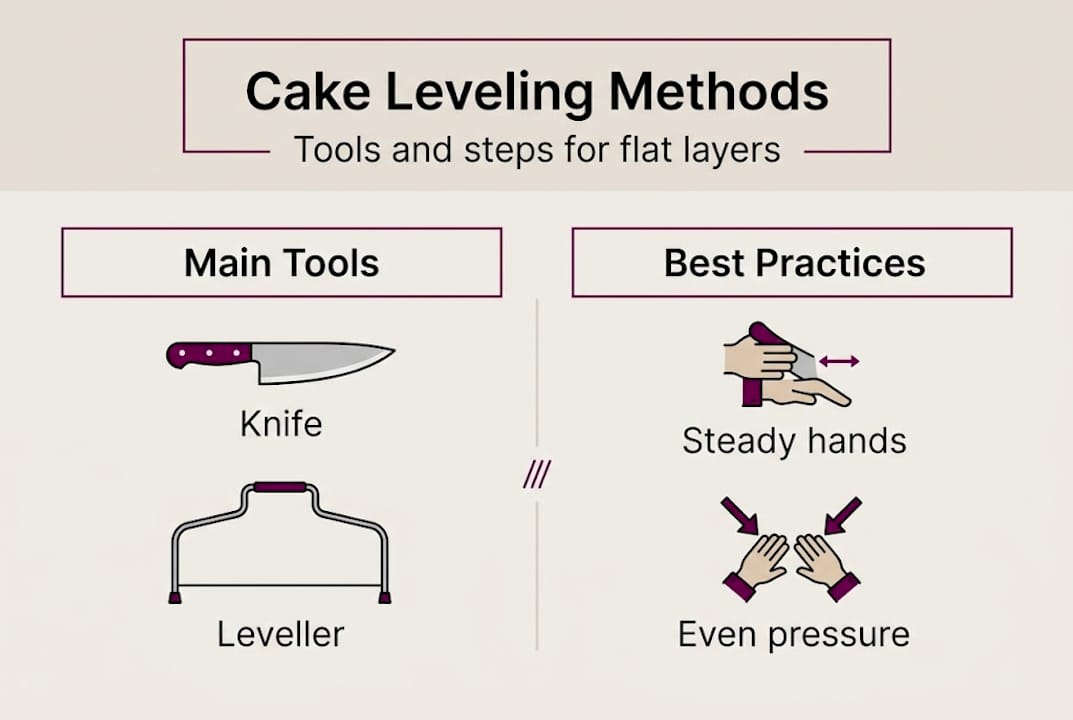
The primary methods for levelling a cake are using a serrated knife or a cake leveller to remove the domed top. Both are brilliant options, but they suit different bakers in different situations. Here is a quick breakdown of what each tool offers:
| Tool | Pros | Cons | Best for |
|---|---|---|---|
| Cake leveller | Precise, consistent height, easy for beginners | Single purpose, bulky to store | Beginners and frequent bakers |
| Serrated knife | Versatile, cheap, already in most kitchens | Needs a steady hand, less consistent | Confident home bakers |
| Dental floss method | No specialist tools needed, surprisingly effective | Fiddly, less precise on tall cakes | Occasional bakers or beginners |
A cake leveller gives beginners more accuracy, while a serrated knife is versatile but needs a steadier hand. Beyond the cutting tool itself, a few extra items will make your life much easier:
- Turntable: Rotating the cake as you cut keeps your angle consistent and your hand steady.
- Cake lifter: Essential for moving delicate layers without cracking or tearing.
- Ruler: Helps you mark the exact height before you cut, especially useful when torting (splitting into layers).
- Cake board: Gives your base layer something solid to sit on while you work.
- Chill time: Not a tool, but just as important. A cold cake is a firm cake, and a firm cake is far easier to cut cleanly.
If you want to explore the full range of kit that makes a real difference in the kitchen, our guide to the best baking tools for home bakers is a great place to start. And if you are still getting to grips with the basics, understanding lining your cake tin properly is another foundational step worth reading up on.
Pro Tip: If you are just starting out, invest in a cake leveller first. It removes the guesswork and lets you focus on building confidence before you move on to freehand knife work.
Step-by-step: How to level a cake like a pro
Once you have your equipment ready, it is time to try your hand at the actual process. The steps are straightforward, but the details matter. Rushing this stage is where most home bakers go wrong.
Preparing your cake
First things first: chill your cake before cutting for a firmer texture, and use a turntable for ease of movement, lifting with a cake lifter when needed. Pop your baked cake into the fridge for at least 30 to 60 minutes. A cold cake holds its crumb together beautifully and gives you a much cleaner cut. Trying to level a warm cake is a recipe for crumbling and frustration.
Using a serrated knife
- Place your chilled cake on a turntable on top of a cake board.
- Use a ruler to measure the height of the lowest point of the cake (usually the edge). Mark this height all the way around the side with toothpicks.
- Hold your knife level with the toothpick line and begin sawing gently, rotating the turntable slowly as you go.
- Use light, back-and-forth strokes rather than pressing down. Let the blade do the work.
- Once the dome is removed, lift the top away cleanly using a cake lifter or palette knife.
Using a cake leveller
- Set the wire of the leveller to the correct height using the adjustable guide.
- Place the leveller against the base of the cake and push it through in one smooth, steady motion.
- Lift the dome away. Done. It really is that simple.
The no-tool alternative
If you do not have either tool to hand, the toothpick and dental floss method works surprisingly well. Push toothpicks into the side of the cake at your desired height, all the way around. Then hold a length of unflavoured dental floss taut against the toothpicks and pull it through the cake in one smooth motion. It is a bit fiddly, but it gets the job done.
“The key to a clean cut is minimal pressure and maximum patience. Let the tool move through the cake rather than forcing it. One slow, steady pass beats three rushed ones every time.”
For more guidance on getting consistent results from your oven before you even reach the levelling stage, our tips on how to bake evenly every time are well worth a read. And if you want to see how levelling fits into the bigger picture of finishing a cake beautifully, check out our guide to professional cake results.
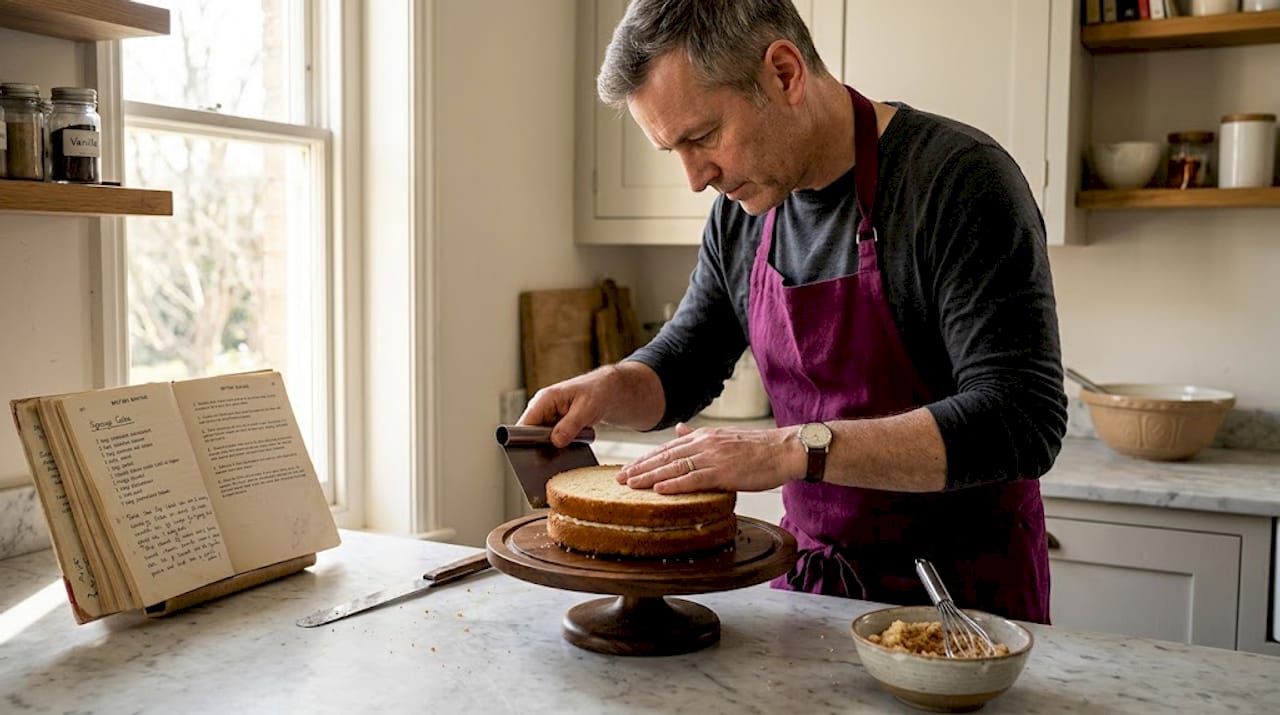
Pro Tip: Always save your offcuts. They are perfect for taste-testing your filling combinations before you commit to the full assembly.
Splitting cakes for multi-layer masterpieces
Levelling is just the start. Splitting your cake opens up a whole world of decorating possibilities. This technique is called torting, and it is how bakers create those gorgeous multi-layered showpieces packed with fillings.
Torting simply means slicing a single cake horizontally to create two or more thinner layers. Each layer gets its own filling, which means more flavour, more visual impact when you cut into it, and a more impressive overall structure. It is a brilliant technique to add to your repertoire, whether you are making a classic Victoria sponge or something more ambitious like a birthday cake with multiple flavoured layers.
How to tort a cake
For torting, score the side at the midpoint with a knife or ruler first, then saw through using a turntable or slow, steady motion. Here is the full process:
- Level your cake first so you have a flat top to work from.
- Measure the height of the cake and mark the midpoint all the way around using toothpicks or a ruler and a small knife.
- Set your cake leveller to the marked height, or hold your serrated knife at that point.
- Begin cutting slowly, rotating the turntable as you go. Keep your elbow tucked in and your wrist steady.
- Once the cut is complete, slide a cake lifter or large palette knife under the top layer and transfer it carefully to a cake board.
- Repeat if you want three or more layers.
| Method | Steps involved | Time needed | Precision level |
|---|---|---|---|
| Serrated knife | Mark, steady hand, slow saw | 5 to 10 minutes | Medium |
| Cake leveller | Set height, push through | 2 to 3 minutes | High |
| Dental floss | Mark with toothpicks, pull through | 5 minutes | Low to medium |
Practice with a knife improves results over time, but levellers are ideal for precision and multiple identical cuts like torting. If you are new to torting, start with a single split and work your way up. The more you do it, the more natural it feels.
For extra ideas on making your cakes look stunning, our professional instant tips article is full of quick wins. And if you are just getting started with decoration, our beginner tips for decorating guide has everything you need to build from the ground up.
Pro Tip: Practise your torting technique on a simple sponge before attempting it on a showpiece cake. A plain Victoria sponge is perfect for building that steady hand.
Troubleshooting and finishing: Common mistakes and perfect stacking
You have levelled and split your cake. Now here is how to troubleshoot issues and achieve a professional finish. Because even with the best technique, things do not always go to plan. Knowing how to fix common problems is just as important as knowing how to avoid them.
Common levelling and stacking faults
- Slanted cut: Usually caused by tilting your knife or not rotating the turntable evenly. Fix it by trimming a thin slice from the higher side with a serrated knife.
- Crumbling layers: Often a sign the cake was too warm when cut. Next time, chill for longer. For now, use a thin layer of buttercream as a “glue” to hold crumbs in place before stacking.
- Wobbly stack: This usually comes down to uneven layers or insufficient support. Make sure each layer is genuinely flat before adding the next, and consider using a cake board between layers for extra stability.
- Filling squeezing out: You have been too generous with the filling or have not left a border around the edge. Pipe a buttercream dam (a ring of firm buttercream around the edge) before spooning in softer fillings like jam or ganache.
- Air pockets between layers: These create weak spots and can cause the cake to sink unevenly over time.
On that last point, after stacking, gently press layers together to eliminate air pockets, but avoid excess pressure on delicate cakes. It is a fine balance. Too little pressure and you get gaps; too much and you squash the crumb and push filling out of the sides.
“Think of stacking your layers like building a wall. Each brick needs to sit flat and flush. A gentle press with a flat cake board on top is all you need to settle everything into place without damaging what you have built.”
For taller, tiered cakes, internal support is non-negotiable. Our cake dowel guide explains exactly how to insert dowels to keep your structure safe and secure. And if you want to sidestep the most common baking disasters altogether, our article on avoiding cake fails is packed with practical advice.
Finishing touches for a neat stack
- Use a cake scraper around the sides after applying your crumb coat to get a smooth, even finish.
- Chill the assembled cake for 20 to 30 minutes before applying your final layer of buttercream or fondant.
- Check for level at every stage using a small spirit level or by simply stepping back and looking at the cake from eye height.
- A cake board under the base layer gives you something firm to work from and makes moving the finished cake much safer.
Why cake levelling builds baking confidence
Beyond problem-solving, let us consider why levelling can genuinely transform your baking experience. It is not just a technical step. It is a turning point.
When you level a cake for the first time and see that perfectly flat surface staring back at you, something clicks. You realise that the gap between a homemade cake and a bakery-worthy one is not talent. It is technique. And technique is learnable. Every single time.
We hear this all the time from bakers who come to us. They have been baking for years but never quite felt proud of the finished result. Then they discover levelling, and suddenly their cakes look the way they always imagined. That shift in confidence changes everything. You start experimenting more. You try new fillings, new flavours, new decoration ideas. You stop being afraid of ambitious projects because you know your foundation is solid.
The first few attempts might feel a little clunky. Your cut might not be perfectly straight. Your layers might not be exactly equal. That is completely fine. Each cake teaches you something new about how your knife moves, how firm your sponge needs to be, how much pressure is just right. It is genuinely one of those skills that improves faster than you expect.
Our guide to professional appearance tips is a brilliant next step once you have the levelling basics under your belt. Because once your layers are straight, the rest of the decorating process becomes so much more enjoyable.
The baking community is full of people who started exactly where you are now. A bit unsure, a bit wobbly, but absolutely passionate about creating something beautiful. Levelling is the skill that bridges the gap between trying and succeeding. And once you have it, you will wonder how you ever baked without it.
Take your cake skills further with the right supplies
With your confidence and knowledge built, the next step is having the best kit in your kitchen. Because knowing the technique is one thing. Having the right tools to execute it is another entirely.

At The Vanilla Valley, we have been supplying passionate bakers with everything they need since 2009. From cake levellers and turntables to cake boards, fillings, and decorating supplies, everything you need to put today’s skills into practice is right here. Browse our full range of cake decorating supplies and discover why thousands of home bakers trust us to stock their kitchens. And if you want to go even deeper on the tools that make the biggest difference, our guide to master baking tools is the perfect companion to this article. Your next cake is going to be your best one yet.
Frequently asked questions
Why do cakes dome and need levelling?
Cakes dome because the outside sets first during baking, forcing the centre to rise upwards as it continues to cook. Levelling removes this dome so you have a flat, stable surface for stacking and decorating.
Is it better to use a cake leveller or a knife?
A cake leveller gives beginners more accuracy, while a serrated knife is versatile but needs a steadier hand and a bit more practice to get consistent results.
Can you level a cake without special tools?
Yes. The toothpick and dental floss method works well. Push toothpicks in at your desired height around the cake, then pull unflavoured dental floss through at that level for a clean, flat cut.
How can I keep my layers even while stacking?
Gently press layers together after stacking to remove air pockets, but avoid pressing too hard, particularly with lighter or more delicate sponges, as this can compress the crumb and push out your filling.
What is the difference between levelling and torting?
Levelling cuts the domed top off the cake so it sits flat. Torting splits the cake horizontally at the midpoint to create additional layers, giving you more surface area for fillings and a more impressive slice when the cake is cut.