Master tall cake stability: structural tips for success
TL;DR:
- Proper planning, leveling, and chilling are essential to build stable tall cakes.
- Dowels, support systems, and weight distribution are crucial for structural integrity.
- Attention to foundation and support techniques guarantees visually stunning, long-lasting tall cakes.
There is nothing quite as heartbreaking as watching a beautifully decorated tall cake slowly lean to one side, or worse, collapse entirely just before a celebration. It happens more often than you might think, and the frustrating truth is that the real culprits are rarely the decorations themselves. They are almost always structural. Whether you are baking your first multi-tiered showpiece or your fiftieth, getting the foundations right is everything. In this guide, we are sharing our most practical, tried-and-tested structural tips so your tall cakes stand proud, look stunning, and stay that way.
Table of Contents
- Essential foundations: Planning and prepping for tall cake success
- Stacking strategies: Dowels, supports, and cake boards explained
- Mastering weight distribution: Preventing sagging and collapse
- Finishing touches: Decorating for both beauty and stability
- The real secret to show-stopping tall cakes
- Take your tall cake creations further with the right tools
- Frequently asked questions
Key Takeaways
| Point | Details |
|---|---|
| Level and chill layers | Ensuring each cake layer is flat and properly chilled before stacking prevents leaning and collapse. |
| Invest in strong supports | The right dowels, cake boards, and plate systems keep tall cakes standing firm, even when transporting. |
| Distribute weight evenly | Even weight distribution using professional systems stops sagging and ensures long-lasting stability. |
| Decoration with structure in mind | Choose decorating methods and placements that enhance, not compromise, your cake’s strength. |
Essential foundations: Planning and prepping for tall cake success
Every impressive tall cake starts long before the oven is switched on. Proper planning is the unsung hero of structural baking, and skipping this stage is where so many bakers run into trouble.
Before you even measure out your flour, think carefully about the final height of your cake and how many servings you need. These two factors should shape every decision you make from the start. A cake that is too tall for its diameter will always be a wobble risk. A good rule of thumb is to keep the ratio of height to width sensible. Tall and narrow is a recipe for disaster without serious internal support.
Baking even layers is the next non-negotiable step. Uneven sponges create uneven pressure points, and when those layers are stacked, you end up with a structure that is already compromised before you have added a single dollop of buttercream. Use cake strips around your tins to encourage even rising, and resist the urge to open the oven door too early.
Once your layers are baked, a cake levelling tool is your best friend. Running a leveller across the top of each sponge takes just a minute but makes an enormous difference to how stable your final stack will be. As a key piece of advice, level all layers perfectly using a levelling tool and chill cakes before stacking to firm them up. This is advice we stand by completely.
Here is a quick checklist of what to do before stacking:
- Plan your finished height and diameter ratio before baking
- Use cake strips on your tins for even layers
- Level every sponge with a levelling tool once cooled
- Wrap each layer and chill in the fridge for at least two hours
- Prepare your cake boards and supports before assembly begins
Chilling is not optional. A room-temperature sponge is soft, compressible, and far more likely to slide or squash under the weight of additional layers. Once chilled, your cake holds its shape reliably during assembly. This single step alone prevents a huge proportion of tall cake disasters.
“Chilling your cakes before stacking is not about making the process slower. It is about making the result so much better. A cold cake is a confident cake.”
If you want to avoid cake collapse, the preparation stage is where your confidence is built. Rushing it is always a mistake.
Pro Tip: Pop your levelled, filled cakes into the freezer for 20 to 30 minutes rather than the fridge if you are short on time. They will firm up faster and handle much better during stacking.
Stacking strategies: Dowels, supports, and cake boards explained
With your cakes level and chilled, the next crucial step is choosing the right supports for reliable assembly. This is the stage that separates a cake that looks amazing in photos from one that also looks amazing three hours into a party.
Dowels, central rods, and plate systems each serve a purpose. Understanding which tool suits your specific cake is the difference between confidence and crossed fingers.
Here is a comparison to help you choose:
| Support type | Best for | Pros | Cons |
|---|---|---|---|
| Wooden or plastic dowels | Standard tiered cakes | Affordable, widely available | Must be cut precisely |
| Central threaded rod | Very tall cakes | Maximum vertical stability | Requires more skill to fit |
| SPS plate system | Heavy or extra-tall cakes | Even weight distribution | Higher cost |
| Bubble tea straws | Lighter cakes and smaller tiers | Easy to cut and insert | Not suitable for heavy tiers |
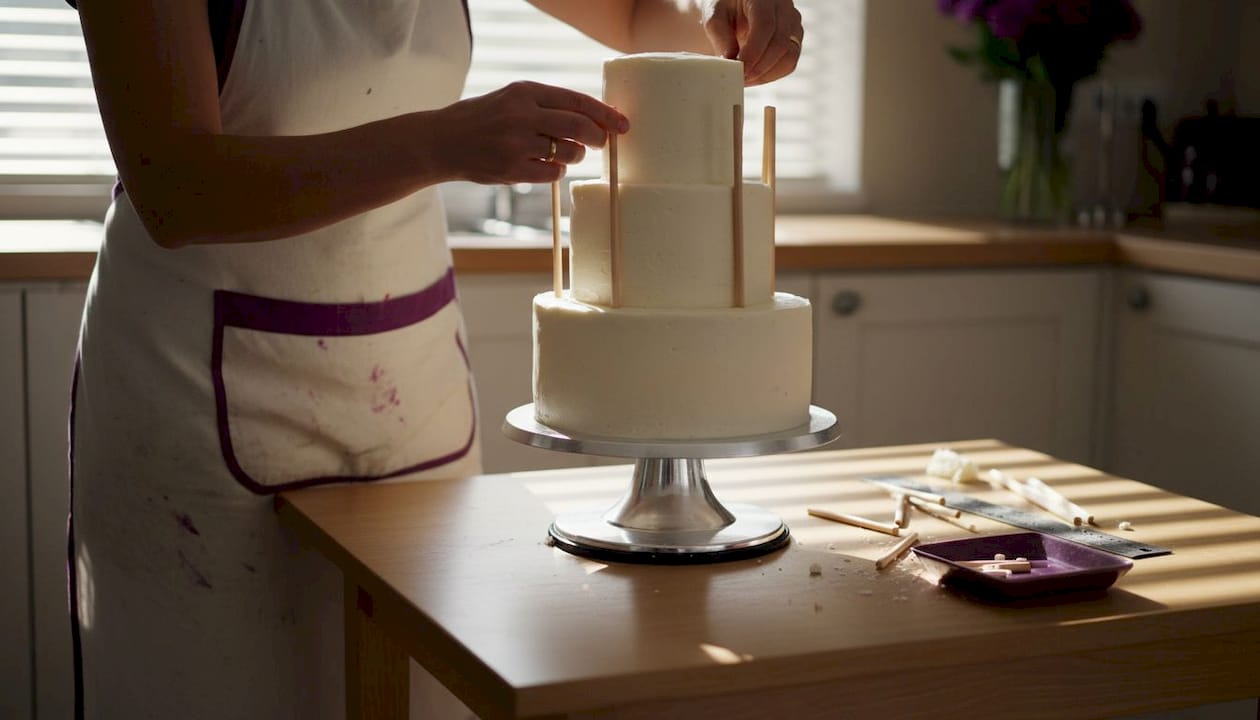
Our cake dowel stability guide goes into much greater detail on this, but here is the essential process for inserting dowels correctly.
- Place the next tier’s cake board on top of the lower tier and trace around it lightly with a cocktail stick or skewer to mark the area.
- Insert your first dowel straight down through the centre of the marked circle, pressing it fully to the cake board beneath.
- Mark the dowel at the level of the cake’s surface, remove it, and cut all remaining dowels to exactly the same length.
- Insert all dowels evenly within the marked circle, spacing them so they fall just inside the area that will bear the weight of the tier above.
- Place a thin cake board on top of the dowels, then carefully lower your next tier into position.
The thin cake board between tiers is often the step that gets skipped, and it is a genuinely important one. It spreads the load evenly across all the dowels rather than letting the sponge above sink between them. When choosing cake boards for this purpose, go for a drum board for the base and thinner card boards between tiers.
Alignment really does matter. Dowels that lean even slightly can create uneven pressure, which gradually pushes layers out of true. Use a spirit level or a straight ruler to check each dowel is perfectly vertical before committing.
Pro Tip: Always insert one dowel in the very centre of your bottom tier first. This central anchor point makes it much easier to place the remaining dowels in a symmetrical pattern around it for balanced support.
Mastering weight distribution: Preventing sagging and collapse
Having chosen your dowels and boards, it is vital to understand how weight is distributed throughout the cake so every layer stays upright. This is where a lot of bakers go wrong, even experienced ones. They focus on the individual components without thinking about how the whole structure carries load from the top down.
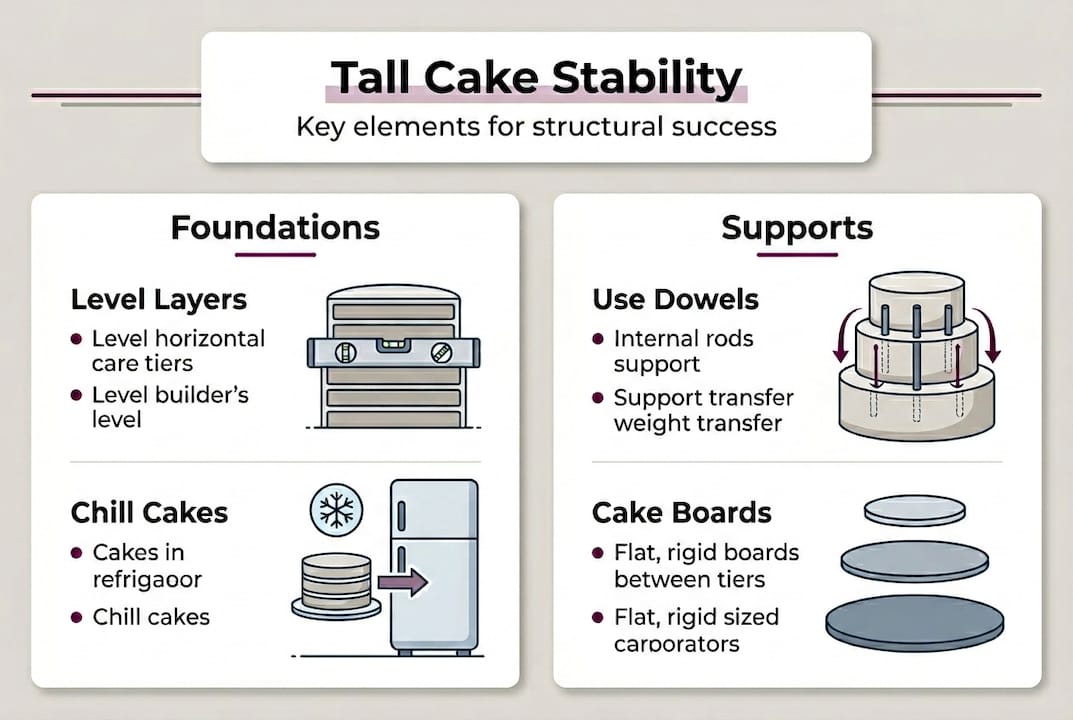
Think of a tall cake like a building. Every floor transfers its weight to the floor below, and ultimately to the foundations. If any level in that chain is poorly supported or misaligned, the whole thing becomes vulnerable. In cake terms, this means every tier must sit squarely on its supports, and those supports must reach down to a solid base board.
Common mistakes that lead to sagging or leaning include:
- Placing dowels too close to the edge of the tier, outside the weight-bearing area
- Using too few dowels for the size and weight of the tier above
- Allowing butter cream or ganache fillings to be applied too thickly between layers
- Skipping the inter-tier cake board entirely
- Stacking warm or room-temperature cakes without chilling first
For standard tiered cakes, good-quality plastic or wooden dowels are excellent. But when you are working with especially tall or heavy cakes, the stakes are higher. SPS or plate systems for extremely heavy or tall cakes provide even weight distribution beyond what standard dowels can offer. These systems use plates that slot together with pillars, creating a rigid framework that takes the weight entirely off the sponge itself. The cake essentially becomes decorative around a proper support structure.
Here is a quick data comparison to illustrate when to step up your support system:
| Cake height | Recommended support | Weight capacity |
|---|---|---|
| Up to 15cm | Plastic dowels | Light to medium |
| 15cm to 25cm | Wooden dowels with central rod | Medium to heavy |
| 25cm and above | SPS plate system | Heavy to very heavy |
Knowing when to use dowels or plates comes with experience, but this table gives you a solid starting point. And if you are planning to transport your finished cake, the support system matters even more. Read our tips on transporting tall cakes safely before you book that delivery slot.
“A tall cake with even weight distribution is not just more stable. It is more satisfying to cut and serve, because every slice comes away cleanly rather than crumbling under the pressure of a sagging tier above.”
Getting weight distribution right is genuinely exciting once it clicks. It transforms the way you approach every multi-tiered build.
Finishing touches: Decorating for both beauty and stability
Once the internal supports are in place, your attention turns to decoration, where creative ambitions must meet structural realities. This is the most visible part of the process, and it is also where structural mistakes are most likely to creep back in if you are not careful.
The golden rule is this: decoration should never compromise the support system. That sounds obvious, but it is remarkably easy to get carried away adding heavy fondant panels, towering sugar flowers, or elaborate figurines without thinking about what all that weight is doing to the cake beneath.
Before you start, consider the following:
- Fondant and ganache coatings add weight. Apply them in even, controlled layers and allow each to set before adding the next.
- Sugar decorations like flowers, butterflies, and figurines should be made in advance and allowed to dry fully so they are as light as possible before attachment.
- Edible glue is your ally for attaching decorations securely without adding structural stress through physical pressure or pressing.
- Toppers should be centred precisely over the cake’s internal support. An off-centre topper creates an uneven load at the very top of the structure.
- Fresh flowers and non-edible decorations must be used with food-safe picks or sleeves to prevent contamination and must be placed after the cake reaches its final location.
For a proper grounding in decorating fundamentals, our starting cake decorating tips guide is a brilliant place to start. And if you want to understand what separates a good-looking cake from a genuinely professional cake appearance, the detail is in the finishing layers.
One area that catches people out is the ganache or buttercream crumb coat. This first thin layer locks in crumbs and gives a smooth base for further decoration, but it also helps unify the structural sections of the cake visually. A beautifully smooth crumb coat, chilled firm before the next layer goes on, levels layers perfectly and makes the final result look polished and intentional.
For transporting a decorated tall cake, always box it at its destination if possible. If you must transport it pre-decorated, use a non-slip mat beneath the cake board, drive smoothly, and never place anything on top of or next to the box.
Pro Tip: Use edible glue sparingly but precisely. A small amount on a fully dried sugar decoration is far stronger than a large amount on one that is still slightly soft. Patience at this stage pays off beautifully.
The real secret to show-stopping tall cakes
Here is something we genuinely believe, having seen hundreds of cake projects come through our doors and social feeds over the years. The bakers who consistently produce the most stunning tall cakes are not always the ones with the most expensive tools or the most elaborate designs. They are the ones who have mastered the fundamentals and refuse to cut corners on preparation.
There is a tendency in the baking community to get excited about new techniques, new support systems, and new decorating trends. And we love that energy. But the truth is that a beautiful central rod system will not save a cake whose layers were not levelled properly. An SPS plate system will not fix a structure that was stacked warm.
Following the essential cake steps with real discipline, every single time, is what produces reliable results. Precision in planning, levelling, and weight distribution matters more than any individual product or technique.
Creative decorating is one of the great joys of this craft, and we never want to dampen that spirit. But creativity built on a solid structural foundation is where the real magic happens. When you know your cake is not going to lean or collapse, you can pour your energy into the details that make people gasp. That is the sweet spot we all want to reach.
Take your tall cake creations further with the right tools
Now that you are equipped with expert techniques, the final ingredient is access to professional supplies that actually deliver on quality. At The Vanilla Valley, we have been helping bakers across the UK find exactly what they need since 2009, from robust cake boards and precision dowels to the full range of tall cake decorating supplies that make ambitious projects feel achievable.
Whether you are building your first tiered cake or taking on a showstopper for a competition, having the right materials makes every step easier and every result more reliable. We stock trusted brands, offer free delivery options, and our team genuinely loves helping bakers at every level. Pop into our North Cardiff store or browse our full range online. Your next tall cake is going to be brilliant, and we want to help you get there.
Frequently asked questions
What is the best method to stabilise a tall cake?
Use dowels and cake boards between each tier as a minimum. For cakes that are especially tall or heavy, SPS or plate systems provide even weight distribution beyond what standard dowels can manage.
How do I prevent my tall cake from leaning?
Ensure every layer is levelled and thoroughly chilled before stacking, and use precise dowel placement so the load is evenly spread across every tier. Level all layers carefully and never rush the chilling step.
Can I stack warm cakes for a tall structure?
No. Always chill your cakes before stacking because a warm sponge is soft and will compress, slide, or deform under the weight above. Chilled cakes hold their shape reliably and make stacking far more controlled.
When should I use a plate support system instead of dowels in tall cakes?
Choose a plate or SPS system when your cake is extra tall, particularly dense, or when you need to transport it over a longer distance. These systems offer structural rigidity that standard dowels simply cannot match for demanding builds.
Recommended
- How to Use Cake Dowel for Tiered Cake Stability - The Vanilla Valley
- 7 Best Cake Boxes for Tall Cakes and Top Tips for UK Bakers - The Vanilla Valley
- Stop cakes sticking to the tin: expert tips for bakers - The Vanilla Valley
- Make your cakes look professional instantly: simple tips - The Vanilla Valley