
Common mistakes when using fresh flowers on cakes
TL;DR:
- Using fresh flowers on cakes requires careful flower selection and preparation to avoid toxicity and contamination risks. Proper hygiene, stem isolation, and timing are essential for safe and beautiful cake decoration. Collaboration with florists and proper sourcing help ensure flower safety and optimal presentation.
Fresh flowers look stunning on cakes. There is no denying that. But the common mistakes when using fresh flowers on cakes are more widespread than most decorators realise, and the consequences range from ruined aesthetics to genuine food safety concerns. Whether you are placing a handful of roses on a birthday sponge or arranging a full cascade on a wedding tier, there are real risks that go far beyond just choosing a pretty bloom. This guide covers the ten most important pitfalls and exactly how to avoid them.
Table of Contents
- Key takeaways
- 1. Common mistakes when using fresh flowers on cakes start with wrong flower choices
- 2. Using florist-grade flowers without checking for pesticides
- 3. Failing to wash and prepare flowers before use
- 4. Inserting stems directly into the cake
- 5. Using floral foam or non-food-safe mechanics
- 6. Overloading the cake with flowers
- 7. Not coordinating properly with your florist
- 8. Ignoring condensation during transport
- 9. Placing flowers too early
- 10. Not having a safe backup plan
- My honest take on fresh flowers and cake decorating
- Stock up on the right tools at The Vanilla Valley
- FAQ
Key takeaways
| Point | Details |
|---|---|
| Toxicity is a serious risk | Flowers like lily of the valley and daffodils are toxic and must never contact cake surfaces. |
| Pesticides matter | Florist-grade imported flowers carry chemical residues that can contaminate edible surfaces. |
| Stem isolation is non-negotiable | Always use food-safe floral picks or wax barriers to prevent moisture and sap migration. |
| Timing affects everything | Place flowers as close to serving time as possible to avoid wilting, condensation, and structural failure. |
| Baker and florist must communicate | Florists often do not know toxicity or pesticide risks without specific guidance from you. |
1. Common mistakes when using fresh flowers on cakes start with wrong flower choices
This is where most problems begin. Many decorators pick flowers based purely on colour and shape without checking whether they are safe near food. Flowers like lily of the valley, hydrangeas, foxglove, and daffodils are toxic and should never touch cake surfaces. These are not rare flowers either. They appear in everyday bouquets and are sold in most high street florists.
There are three categories you need to understand:
- Edible flowers (e.g. violets, pansies, rose petals, lavender): Safe to eat, beautiful on cake, ideal for direct surface placement when sourced correctly
- Food-safe but non-edible (e.g. certain orchids and succulents): Not for eating but generally low risk when isolated from the cake surface
- Toxic flowers (e.g. lily of the valley, foxglove, sweet peas, ranunculus): Must never contact any part of the cake
The safe use of fresh flowers depends first and foremost on knowing which category your chosen blooms fall into before anything else.
Pro Tip: Keep a printed reference list of toxic flowers on your workstation. It takes seconds to check and could save you from a very serious situation.
2. Using florist-grade flowers without checking for pesticides
Even flowers that are not toxic can be genuinely harmful on a cake if they have been treated with pesticides. Florist-grade blooms, especially imported roses, are routinely sprayed with chemicals during growing and transportation. Imported roses can carry glyphosate and other pesticide residues that have no place near edible surfaces.
This is a risk many decorators underestimate because the flowers look perfectly clean. They are not. Always source flowers labelled as organic, culinary-grade, or specifically grown for cake use. If you are sourcing from a local grower, ask directly about their growing practices. Supermarket flowers are a grey area and generally best avoided on cakes unless you can confirm they are chemical-free.
For help choosing flowers that work beautifully and safely, have a look at our edible flower designs guide for inspiration grounded in safe practice.
3. Failing to wash and prepare flowers before use
Even if your flowers are organic and non-toxic, they still need proper preparation. Skipping this step is one of the most common cake decoration errors we see. Bacteria and contaminants on fresh flowers present a real contamination risk, and handling them without hygiene controls can transfer harmful microbes directly to your cake.
Here is what proper flower preparation looks like:
- Rinse flowers gently under cool water to remove surface dirt, insects, and residues
- Pat dry thoroughly with clean kitchen paper before any contact with the cake
- Remove leaves, stamens, and pistils that could shed pollen onto the surface
- Sanitise your hands, tools, and work surfaces before and after handling flowers
- Keep prepared flowers refrigerated in clean water until you are ready to use them
None of these steps take long. But missing them creates hygiene risks that are entirely preventable.
Pro Tip: Prepare your flowers the day before and store them properly in the fridge. Rushing preparation on the day is where corners get cut.
4. Inserting stems directly into the cake
This is arguably the most widespread mistake with cake flowers, and the damage it causes shows up faster than most people expect. Direct insertion of flower stems into fondant or buttercream causes moisture migration that leads to stains and sticky patches within hours. Stems carry water, sap, and potential toxins, and once they are inside your cake, that all begins leaching into the icing.
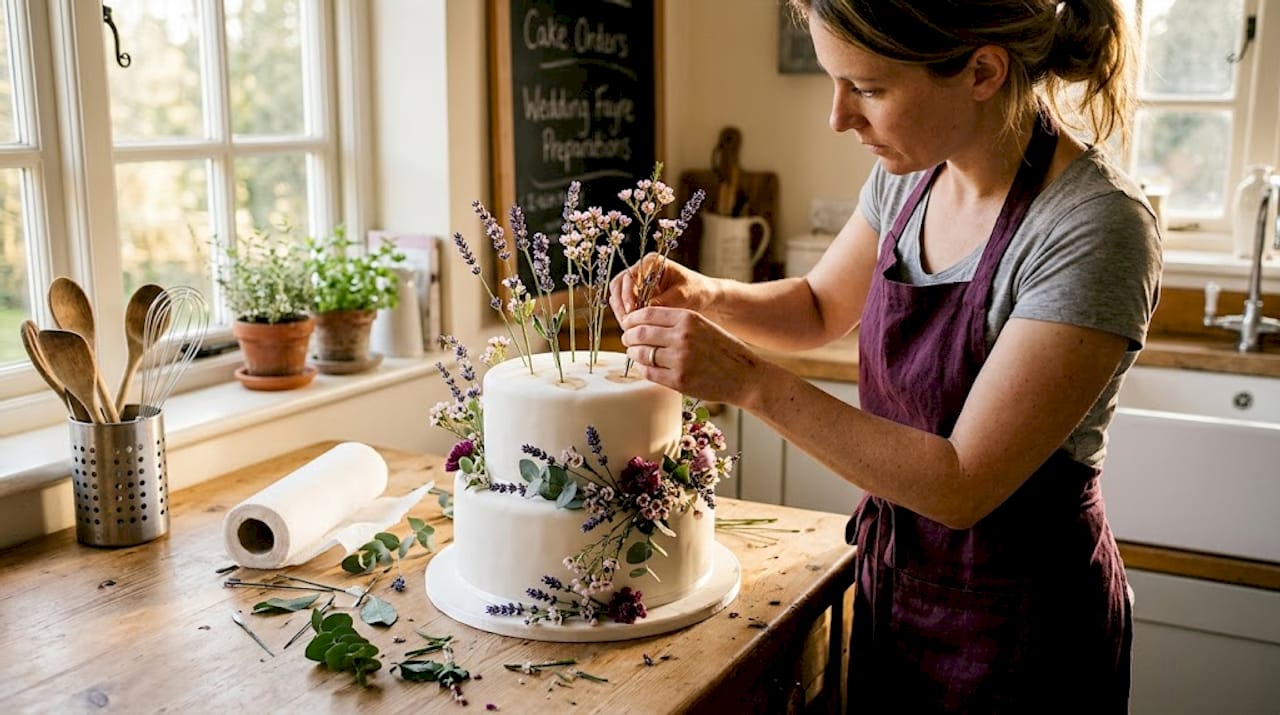
The visual result is discolouration rings and soft, weeping patches around each stem insertion point. On a white fondant cake, those patches can appear within two to three hours of placing unprotected flowers. On buttercream, the effect is even faster.
The fix is straightforward: use food-safe floral picks. Food-safe plastic tubes isolate stems and prevent any moisture from touching the cake while still allowing flowers to appear naturally placed. They are a small investment with enormous impact on the final result.
5. Using floral foam or non-food-safe mechanics
Floral foam is a staple in floristry. It should never be anywhere near a cake. It is not food safe, it sheds particles, and it soaks water in a way that creates exactly the kind of moisture contamination problem we have already discussed. Yet it still appears in cake decorations far too often.
The same applies to standard floral wire that has not been food-safe coated, craft wire, and adhesive tape used in flower arrangements. If any element of your floral mechanics was not designed with food contact in mind, it should not be on the cake. Professionals isolate stems with tubes, wax sealing, or straw barriers to maintain both hygiene and appearance. That is the standard you should be working to.
| Mechanic | Food-safe? | Notes |
|---|---|---|
| Food-safe floral picks | Yes | Best option for stem isolation |
| Parchment-wrapped stems | Yes | Good for short-term placement |
| Food-grade wax dipping | Yes | Excellent moisture barrier |
| Standard floral foam | No | Sheds particles, not food safe |
| Craft wire (uncoated) | No | Can leach metals into cake |
| Adhesive floral tape | No | Contains chemicals unsuitable for food contact |
Pro Tip: If a florist supplies pre-wired flowers for your cake, always check what wire and tape they have used. Ask specifically for food-safe alternatives if needed.
6. Overloading the cake with flowers
Beautiful floral cakes often inspire decorators to keep adding more blooms. At some point, more becomes too much, and not just aesthetically. Structural and timing mistakes with fresh flower decorations cause slow visual failure, cake leaning, and fondant seam cracking due to uneven weight distribution.
Heavy flower clusters on one side of a tier create torque. That torque slowly pulls the tier, particularly if it is stacked on a cake with soft buttercream between layers. A fully loaded top tier with a dramatic flower cascade can begin showing signs of lean within one to two hours at room temperature. Plan your arrangement with weight balance in mind, and consider using lighter blooms or mixing in sugar flowers at heavier points to reduce the load without sacrificing visual impact.
7. Not coordinating properly with your florist
Collaboration between bakers and florists on flower safety and placement is genuinely critical, yet it is skipped surprisingly often. The florist chooses the blooms. You are responsible for what goes on the cake. If those two conversations never happen, the result can be flowers that are treated with chemicals, unsuitable for food contact, or cut in a way that makes proper isolation impossible.
Do not assume your florist knows what “food-safe” means for a cake context. Many brilliant florists have never been asked to supply cake flowers before. Be specific with your brief: tell them you need organic or pesticide-free blooms, that stems should not be pre-wired unless food-safe wire is used, and that you will need a certain stem length for your picks. A five-minute conversation can prevent a genuinely difficult situation on the day.
8. Ignoring condensation during transport
You can do everything right in the kitchen and still run into problems on the way to the venue. Condensation caused by temperature changes during transport is a major, often overlooked cause of discolouration and moisture spots. Moving a cake from a cold fridge to a warm car triggers condensation, and that moisture collects around every insertion point.
Temperature-triggered condensation causes rapid moisture transfer and damage even when stems are wrapped or isolated. The practical answer is to transport the cake at a stable temperature, ideally in an insulated box, and to add flowers on site whenever possible. If flowers must be placed before transport, keep the vehicle cool and minimise the time between the fridge and the venue.
9. Placing flowers too early
Timing is one of the most underestimated floral decoration tips. Fresh flowers begin to wilt, shed pollen, and release moisture from the moment they are placed. Adding them the night before because it feels more relaxed is a common mistake with cake flowers that leads to drooping, browning, and a cake that looks tired before it is even cut.
For most events, flowers should be added no more than two to four hours before serving. For outdoor venues or warm rooms, closer to one hour is safer. If you are using a mix of sugar flowers and fresh blooms, place the sugar ones early for stability and add the fresh ones last, as close to the event as practically possible. For more on combining both approaches well, our guide to achieving a floral cake look is worth bookmarking.
10. Not having a safe backup plan
Even with everything planned perfectly, a stem can crack a pick, a flower can wilt unexpectedly, or a bloom turns out to be unavailable on the day. Decorators who rely entirely on fresh flowers with no contingency often find themselves making hasty decisions under pressure. Those hasty decisions are exactly where safety shortcuts happen.
Have a set of edible versus non-edible alternatives in mind before the day. Keep a few dried flowers or high-quality sugar flowers on hand that match the colour palette. A confident decorator is one who has already solved the problems that have not happened yet.
My honest take on fresh flowers and cake decorating
I have seen so many beautiful cake designs undone by what looked like a small oversight. In my experience, the biggest gap is not knowledge of flower toxicity. Most bakers at least know to avoid obvious risks. The real problem is the gap between preparation and execution on the day.
What I have learned is that fresh flowers actively interact with your cake. They are not neutral decorations you place and forget. Moisture, sap, and pollen migration affect fondant and buttercream quickly, and that interaction only speeds up under warm conditions or transport stress. I have seen pristine white fondant show brown rings within ninety minutes of an unprotected stem being inserted.
My personal approach is this: treat every fresh flower as a potential hazard until it has been checked, prepared, and properly isolated. That sounds cautious, but it is not anti-flower at all. The results when you get it right are genuinely amazing. The combination of a well-prepped bloom in a food-safe pick, placed at the right time, on a well-balanced cake, is one of the most stunning things in cake decoration. It just takes preparation and a honest conversation with your florist.
— steven
Stock up on the right tools at The Vanilla Valley
Getting fresh flowers right on cakes is so much easier when you have the correct supplies to hand.

At The Vanilla Valley, we stock everything you need to use fresh flowers safely and beautifully, from food-safe floral picks and wrapping materials to a full range of cake decorating essentials. We have been supporting bakers and cake decorators since 2009, and our team genuinely loves helping you find the right product for the job. Browse our full range online or pop into our North Cardiff shop. With free delivery options and next day dispatch available, getting stocked up has never been easier.
FAQ
Which flowers are toxic and must never go on a cake?
Lily of the valley, foxglove, daffodils, and hydrangeas are among the most commonly encountered toxic flowers and must never touch any edible surface directly.
Do I need to use floral picks every time?
Yes. Stem isolation using floral picks or food-grade wax is the standard method for preventing sap, moisture, and chemical contamination from reaching your cake.
Can I use supermarket flowers on a cake?
Supermarket flowers are generally not recommended because their pesticide history is unknown. Organic or culinary-grade flowers from a trusted supplier are the safest choice for flower safety on cakes.
How far in advance can I place fresh flowers on a cake?
Fresh flowers should be placed no more than two to four hours before serving to avoid wilting and moisture migration. In warm venues, one hour before serving is a safer target.
Do florists know how to prepare flowers for cakes safely?
Not always. Collaboration between bakers and florists on toxicity and pesticide concerns is critical, as many florists are not aware of specific food safety requirements without clear guidance from the baker.
Recommended
- How to achieve a natural, elegant floral cake look - The Vanilla Valley
- 7 Mistakes to Avoid with Cake Boards and Boxes for Bakers - The Vanilla Valley
- Transform birthday cakes with stunning edible flower designs - The Vanilla Valley
- How to store sugar flowers for lasting cake decorations - The Vanilla Valley