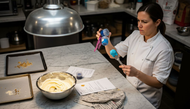
Gel vs Paste Food Colouring: Getting Vibrant Results
Every passionate baker in South Wales knows the frustration of dull colours or streaky icing that ruins an otherwise perfect cake. Clear knowledge of the differences between gel and paste food colouring is the key to unlocking vibrant, professional-looking results at home. By focusing on their unique consistency, concentration, and use in cake decorating, you will gain the confidence to pick the right tool for flawless bakes every time. Bold colour starts by choosing the right colouring for your recipe.
Table of Contents
- Defining Gel and Paste Food Colouring
- Consistency and Concentration Compared
- Uses in Cake Decorating and Baking
- Colour Intensity and Mixing Techniques
- Mistakes to Avoid with Gel and Paste
Key Takeaways
| Point | Details |
|---|---|
| Understand Consistency | Gel is semi-solid and blends quickly, while paste is denser and requires more effort to mix. |
| Choose Wisely | Use gel for general icing and cake batters; opt for paste in delicate, moisture-sensitive decorations. |
| Practice Patience | Gradually build colour intensity to avoid bitter-tasting or muddy results; rushing can damage texture. |
| Avoid Common Mistakes | Prevent overcolouring and incomplete mixing to ensure professional quality in your baking. |
Defining Gel and Paste Food Colouring
Gel and paste food colourings are concentrated colouring agents designed specifically for baking and cake decorating. Both deliver vibrant, professional-quality results that liquid food colouring simply cannot match. The key difference lies in their consistency, mixing properties, and how they interact with different cake bases.
Gel Food Colouring: What You’re Working With
Gel food colouring comes in a thick, concentrated form similar to icing consistency. It sits somewhere between liquid and paste, making it versatile for most amateur bakers. Gels contain water-based pigments suspended in a thick medium, allowing you to achieve deep colours without thinning your batter or frosting.
You’ll notice gel colours are highly concentrated. A tiny amount—often just a toothpick dab—creates rich, saturated colour. This means one jar lasts considerably longer than liquid alternatives, offering better value for your money.
Gel colourings work beautifully in buttercream, royal icing, and fondant. They’re forgiving for beginners because they don’t dramatically change your recipe’s consistency when added properly.
Paste Food Colouring: A Different Approach
Paste food colouring has a thicker, more putty-like texture than gel. It contains concentrated pigments with minimal water content, making it especially useful when you need absolutely no liquid addition to your mixture.
Pastes excel in applications where moisture matters. If you’re working with delicate macarons, meringues, or sugar work, paste colourings won’t compromise your recipe’s chemical balance. Many professional cake decorators prefer pastes for this reason.
Under UK food additive regulations, both gel and paste colourings meet strict safety and quality standards. You’re getting tested, reliable products whether you choose one or the other.
Key Differences at a Glance
- Gel: Thicker than liquid, pourable, water-based, works in most applications
- Paste: Putty-like texture, minimal water, ideal for moisture-sensitive recipes
- Gel: Easier for beginners, more forgiving with measurements
- Paste: Better for professional detail work and meringues
- Gel: Slightly faster mixing time
- Paste: Requires more working to blend thoroughly
Why Consistency Matters
Consistency affects how the colour distributes through your mixture. Gel’s smoother texture blends faster into buttercream, whilst paste’s thickness means you’ll spend more time working it in. For impatient decorators, this matters. For those with time, paste gives superior control and precision.
Both colourings are concentrated enough that you’ll use minuscule amounts. This is genuinely important—overloading your mixture with colouring, regardless of type, creates bitter-tasting cakes and muddy colours rather than vibrant ones.
Here’s a clear comparison of gel and paste food colouring properties for bakers:
| Characteristic | Gel Food Colouring | Paste Food Colouring |
|---|---|---|
| Consistency | Thick, semi-solid | Dense, putty-like |
| Water Content | Moderate | Minimal |
| Ease of Mixing | Blends quickly | Needs thorough kneading |
| Suitable For | Buttercream, royal icing | Fondant, sugarpaste, marzipan |
| Colour Intensity | Bright, buildable | Deep, highly saturated |
| Impact on Recipe | Less disruptive | Maintains structural integrity |
Gel and paste colourings are not interchangeable in every recipe, but understanding their basic differences helps you choose the right tool for your project.
Cakes decorated in South Wales kitchens benefit from understanding these distinctions. Local bakers attending Cake International competitions often credit precise colour choice as part of their success.
Pro tip: Buy small quantities of both gel and paste to test in your regular recipes—you’ll quickly discover which works best for your decorating style and the specific cakes you love making.
Consistency and Concentration Compared
Understanding how gel and paste differ in consistency and concentration is crucial for getting the colours you actually want. These physical properties directly affect how easily you blend them, how much you need to use, and whether your final result looks professional or muddy.
The Thickness Factor
Gel food colouring has a semi-solid jelly-like consistency that feels slightly thicker than buttercream. You can squeeze it from a bottle or scoop it with a cocktail stick. This middle-ground texture makes gels approachable for amateur bakers—they’re not runny like liquids, but not stiff like pastes.
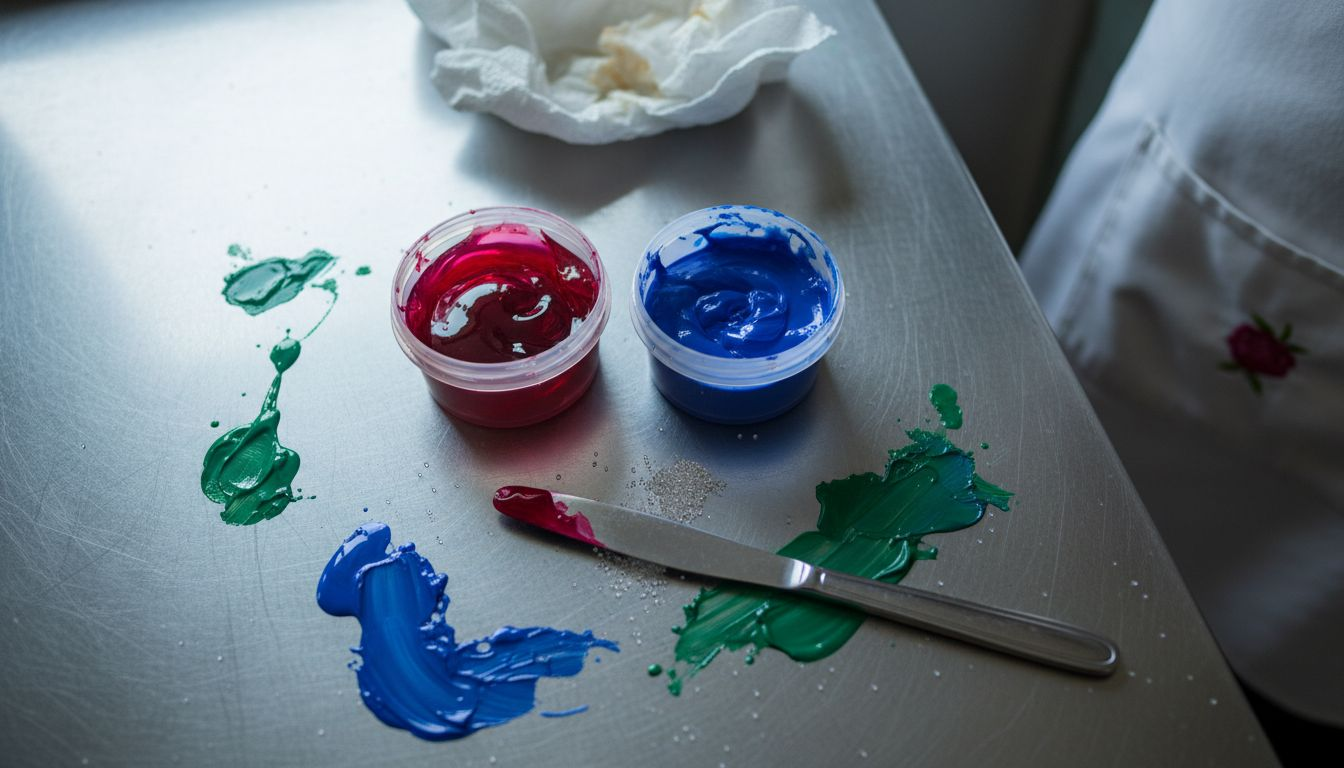
Paste colourings are noticeably thicker and denser. Imagine working with modelling clay rather than frosting. This heaviness means you need a different technique to incorporate them properly into your mixtures.
Concentration: Less Is More
Both gels and pastes are highly concentrated. A tiny amount goes a long way. With gel, start with a toothpick dab. With paste, use even less—roughly the size of a pea for a full cake’s worth of colour.
This concentration difference matters enormously for your wallet. One jar of gel or paste outlasts several bottles of liquid colouring. Amateur bakers on a budget quickly notice this advantage.
Concentration also affects colour intensity. Pastes typically deliver slightly deeper, more saturated colours because they contain higher pigment levels with minimal filler. Gels offer vibrant results but may require slightly more working into your mixture to achieve identical saturation.
How They Behave Differently
Gel blends smoothly and relatively quickly into buttercream, royal icing, and fondant. The water content helps it distribute evenly. You’ll notice colour appearing within 30-45 seconds of mixing.
Paste requires more elbow grease. The dense texture means you’re essentially kneading colour into your icing, similar to working food colouring into fondant. This takes longer but gives you superior control over the final shade.
Quick Comparison
- Gel: Semi-solid, flows slightly, mixes in 30-45 seconds, vibrant colours
- Paste: Very thick and dense, requires kneading, takes 1-2 minutes to blend, intensely saturated colours
- Gel: Better for delicate icings and batters
- Paste: Superior for meringues, sugar work, and moulded decorations
Paste colourings demand patience during mixing, but deliver unmatched colour intensity and won’t compromise moisture-sensitive recipes.
For South Wales bakers decorating competition cakes, the difference between a rushed application and properly blended colour separates good results from winning ones. Take your time with either type, and the results speak for themselves.
Pro tip: Warm your paste colouring slightly by rubbing the jar between your palms before use—this softens it slightly and reduces mixing time without adding moisture to your recipe.
Uses in Cake Decorating and Baking
Gel and paste food colourings serve different purposes depending on what you’re creating. Knowing which to reach for saves time, prevents frustration, and delivers professional results every single time.
Gel Colourings: The Versatile Workhorse
Gel food colourings excel for tinting icings and batters. When you’re mixing buttercream for a sponge cake, gel blends smoothly without adding excess moisture. Royal icing takes gel colour beautifully, creating glossy, even finishes perfect for piping intricate details.
You’ll use gels for most general cake decorating tasks. Tinting fondant, colouring ganache, or adding subtle shades to cake batter all work brilliantly with gel. The water content helps the colour distribute evenly throughout your mixture.
Gels work wonderfully for creating vibrant icing effects that amateur bakers rely on. If you’re new to decorating, gel is your safest starting point.
Paste Colourings: Precision and Intensity
Paste colourings shine when you need serious colour depth without diluting your mixture. Sugar paste flowers, marzipan figures, and fondant decorations all benefit from paste’s concentrated pigment load.
When creating hand-modelled decorations—roses, leaves, or character toppers—paste delivers intensity that gels struggle to match. The thick consistency means you’re adding almost no liquid to delicate work that requires structural integrity.
Fondant and sugarcraft projects demand paste’s concentrated colour and non-diluting properties. Professional decorators prefer pastes for competition cakes precisely because they maintain texture whilst delivering stunning colour.
Where Each Truly Shines
- Gel: Buttercream, royal icing, cake batters, ganache, general tinting
- Paste: Fondant, sugar flowers, marzipan figures, dry decorations, competition work
- Gel: Quick mixing, smooth blending, glossy finishes
- Paste: Maximum colour intensity, structure preservation, fine detail work
Real-World Scenarios
You’re making a birthday cake with pale pink buttercream? Grab gel. You’re hand-modelling a delicate sugar flower for a wedding cake? Paste is your answer. You’re tinting fondant for covering? Either works, but paste gives richer colour with less working time.
For South Wales bakers juggling multiple projects, understanding these distinctions means fewer failed batches and more confident decorating.
Use this reference to select the ideal colouring for different cake decorating tasks:
| Decorating Task | Recommended Colouring | Reason |
|---|---|---|
| Tinting buttercream | Gel | Smooth blend, no excess moisture |
| Modelling sugar flowers | Paste | Strong pigment, preserves structure |
| Colouring cake batter | Gel | Even distribution, gentle texture |
| Competition figures | Paste | Rich intensity, fine detail |
| Simple icing effects | Gel | Fast, glossy results |
Gel colours work best for smooth applications and batters, whilst paste colours excel in hand-modelled and structural decorations where moisture matters.
Pro tip: Keep both gel and paste in your decorating kit—gel for everyday cakes and paste for special projects—and you’ll rarely face a colouring challenge you can’t solve.
Colour Intensity and Mixing Techniques
Getting vibrant results depends on understanding how to build colour intensity properly and mixing each type correctly. Rushing this step ruins cakes. Taking your time transforms them into showstoppers.
Building Colour Intensity with Gel
Gel food colourings allow you to layer colour gradually. Start with a tiny amount—literally a toothpick dab—and mix thoroughly. Assess the shade. Add more if needed. This approach prevents over-colouring, which creates bitter tastes and muddy hues.
Precise mixing and layering lets you adjust tone with confidence. You’re building towards your target colour rather than guessing and overshooting. This control is why gels suit beginners beautifully.
Gels blend effortlessly into creams and batters, providing bright, saturated shades quickly. You’ll see colour developing within 30 seconds of mixing. No surprise failures. No streaking.
Building Colour Intensity with Paste
Paste requires patience and technique. The thick consistency means colour doesn’t distribute instantly. You’re essentially kneading pigment into your fondant or marzipan, similar to conditioning dough.
Start small—a pea-sized amount—and work it through your mixture thoroughly. The colour gradually intensifies as you knead. Keep going until you achieve uniform colouration without streaks or clumping.
Superior pigment density means paste delivers deep, rich colours with minimal quantity. One tiny amount goes further than gel, creating stunning intensity for special projects.
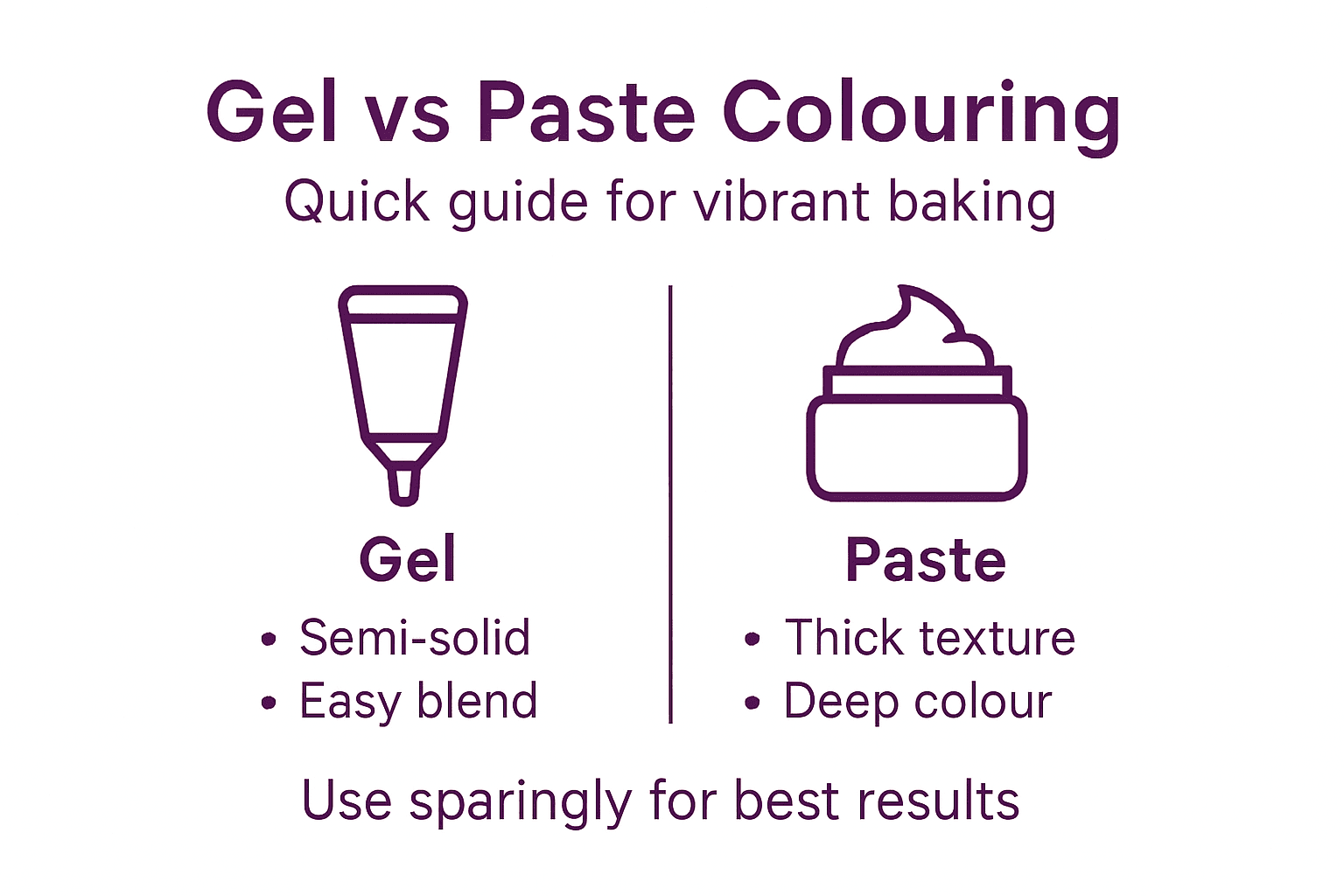
Practical Mixing Steps
For gel colouring:
- Add a toothpick dab to your mixture
- Mix for 30-45 seconds using a spatula
- Check colour against your target
- Add more if needed and repeat
For paste colouring:
- Add a pea-sized amount to your mixture
- Knead thoroughly for 1-2 minutes
- Assess colour saturation and evenness
- Continue kneading if streaks remain
Common Mistakes to Avoid
- Adding too much colour at once (you can’t remove it)
- Stopping mixing too early with paste (streaks ruin appearance)
- Mixing gel too quickly without checking progress
- Using paste in delicate batters (it won’t blend properly)
Building colour intensity gradually with either gel or paste prevents wasted batches and produces professional, vibrant results.
South Wales bakers who master these techniques rarely need to remake batches. Their first attempt succeeds. When you’re preparing for Cake International standards, that consistency matters enormously.
Pro tip: Mix gel or paste into a small amount of your base ingredient first, creating a concentrated “colour paste,” then stir that into your full batch—this prevents uneven mixing and saves time considerably.
Mistakes to Avoid with Gel and Paste
One wrong move with food colouring can ruin an entire batch. Learning what not to do saves time, money, and frustration. These pitfalls catch even experienced bakers occasionally.
The Overcolouring Trap
Adding too much colourant is the most common mistake. A toothpick dab feels tiny. You think more colour means better results. It doesn’t work that way. Excess colouring creates bitter-tasting cakes and muddy, unappealing hues.
Adding excessive colourant also affects icing consistency, making buttercream runny or fondant too stiff for decoration. You’ve now ruined your entire mixture. Start over. Learn from it.
With gel, a toothpick dab colours most batches adequately. With paste, use approximately a pea-sized amount. Resist the urge to add more immediately.
Incomplete Mixing Problems
Stopping too early when mixing creates uneven colouration and streaking. Gel needs 30-45 seconds of thorough mixing. Paste requires 1-2 minutes of proper kneading. Both demand patience you might not naturally have.
Streaky fondant looks unprofessional. Blotchy buttercream looks rushed. These aren’t acceptable for competition cakes or special occasions. Commit to complete mixing before assuming you’re finished.
Choosing the Wrong Type
Using paste where gel would work better creates poor colour spread. Using gel for delicate decorations dilutes your mixture unnecessarily. Understanding which suits your project prevents these avoidable errors.
Never substitute standard liquid food colourings for gel or paste interchangeably. They differ dramatically in concentration and consistency. Liquid colouring will thin your icing significantly. Gel and paste won’t. This fundamental difference matters for recipe success.
Texture Damage You Can’t Fix
Adding colouring too quickly to delicate mixtures can damage texture irreparably. Royal icing becomes grainy. Meringue weeps. Macarons fail entirely. Take time incorporating colour gradually, especially with moisture-sensitive recipes.
Common Mistakes Summary
- Adding too much colour at once (impossible to remove)
- Incomplete mixing (causes streaking and blotchiness)
- Choosing the wrong type for your application
- Using liquid colouring as a substitute
- Adding colour too quickly to delicate mixtures
- Mixing at high speed instead of folding gently
Thorough, patient mixing with the correct colouring type prevents nearly every colouring disaster amateurs face.
South Wales bakers who avoid these mistakes consistently produce professional results. Their cakes photograph beautifully. Their flavours remain true. Their decorations look intentional rather than rushed.
Pro tip: Keep a small test batch of your base icing or fondant separate, colour it first, assess the final shade, then add colouring to your full batch—this prevents total batch failure if you misjudge the amount.
Master Vibrant Colours with the Right Tools from The Vanilla Valley
Choosing between gel and paste food colouring can be challenging when aiming for professional cake decorating results without risking texture or taste. Whether you seek the smooth blending of gel colourings for buttercream or the intense pigment power of paste for delicate sugar flowers, understanding these differences is key. At The Vanilla Valley, we appreciate these needs and offer a carefully curated range of high-quality food colourings alongside essential cake decorating supplies to support both beginners and seasoned pros.
Don’t let colour choice hold back your creativity. Explore our collection at The Vanilla Valley and enjoy trusted brands, expert advice, and perks like free delivery and loyalty rewards. Test different gels and pastes, find your perfect match, and transform your cakes with vibrant, lasting shades. Start elevating your baking today by visiting The Vanilla Valley Online Store and unlock professional colour results that make every cake a masterpiece.
Frequently Asked Questions
What is the difference between gel and paste food colouring?
Gel food colouring is thicker than liquid, offering vibrant results and is easy for beginners to use. Paste food colouring has a putty-like texture, is more concentrated and ideal for moisture-sensitive recipes.
How do I achieve the right colour intensity with gel food colouring?
Start with a tiny amount, such as a toothpick dab, and mix thoroughly into your mixture. Gradually add more if needed, which allows for better control and prevents over-colouring.
Can I use paste food colouring in my buttercream icing?
While you can, it is generally not recommended due to its thicker consistency. Paste is better suited for tasks requiring precise colour application, like modelling decorations, while gel works well in buttercreams and icings for even blending.
What are the best practices for mixing paste food colouring?
When using paste food colouring, start with a pea-sized amount and knead it thoroughly into your mixture for 1-2 minutes to ensure uniform colour distribution without streaks.