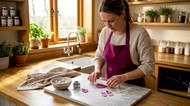
How to create sugar flowers for wedding cakes
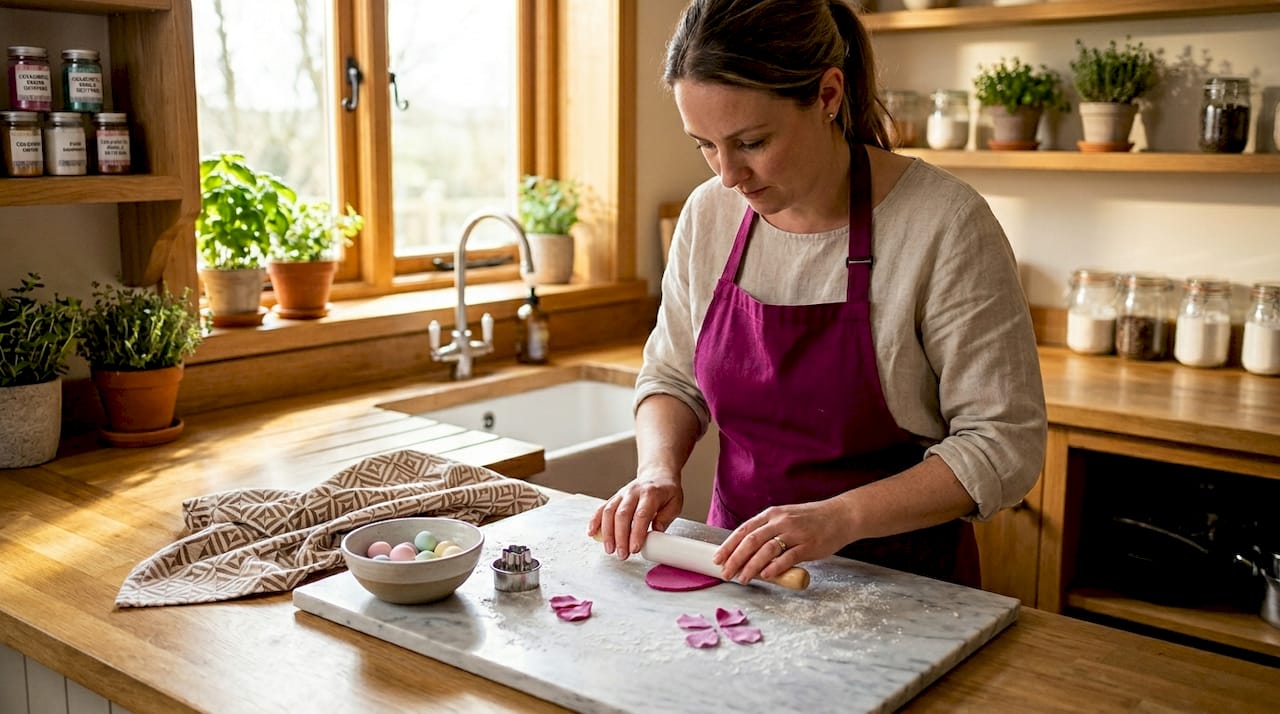
TL;DR:
- Creating sugar flowers for wedding cakes relies on proper materials, tools, and a clear process rather than natural talent. Skilled use of gum paste, wired petals, and drying techniques results in realistic, durable decorations that can be made weeks in advance. Beginners can start with simple designs and safe flower choices, building confidence through practice and proper storage.
There is a moment every amateur baker knows well. You see a wedding cake covered in impossibly lifelike roses and think, “I could never do that.” The truth? You probably can. Learning to create sugar flowers for wedding cakes is less about natural talent and more about having the right materials, the right tools, and a clear process to follow. It takes patience, yes. But the payoff is extraordinary. A hand-crafted sugar flower on a wedding cake does something no printed topper or shop-bought decoration can: it makes people stop, lean in, and say, “Wait, are those real?”
Table of Contents
- Understanding the materials and tools for sugar flowers
- Making wired sugar flowers step by step
- Comparing sugar flowers with other edible flower options
- Safety considerations and selecting the right flowers for cakes
- Storing and preparing sugar flowers before cake assembly
- Learning opportunities and workshops to improve your sugar flower skills
- The art and craft of sugar flowers: a baker’s perspective
- Shop cake decorating supplies and sugarcraft in Cardiff
- Frequently asked questions
Key Takeaways
| Point | Details |
|---|---|
| Use gum paste for realism | Gum paste dries hard and thin, letting you create delicate, lifelike sugar flowers that hold their shape well. |
| Invest in right tools | Having proper wires, cutters, veiners, and drying surfaces is crucial for successful sugar flower crafting. |
| Dry flowers fully | Ensure petals are hard and not floppy before assembling to maintain natural curves and durability. |
| Verify flower safety | Not all edible-looking flowers are food-safe; always confirm their safe use on cakes to avoid toxicity. |
| Plan ahead | Sugar flowers can be made weeks in advance if stored correctly, reducing last-minute stress. |
Understanding the materials and tools for sugar flowers
Before you even think about shaping a petal, you need to understand what you are actually working with. Not all sugar-based products are the same, and choosing the wrong one is the most common reason beginners get frustrated.
Gum paste and sugar paste dry hard, which means you can roll them paper-thin and create petals that genuinely hold their shape. This is the key difference from fondant, which stays soft and pliable. Fondant is brilliant for covering cakes smoothly, but it will not give you a delicate, structured flower that stands proud from a tiered wedding cake. For wired flowers especially, you need that hard-dry quality. If you are unsure which paste to start with, our guide on choosing sugarpaste and modelling paste breaks it down beautifully.
Beyond paste, the tools you invest in will make or break your results. Here is what you genuinely need:
- Floral wires in various gauges (26, 28, and 30 gauge cover most flowers)
- Petal and leaf cutters shaped to match the flower you are making
- Foam pad for thinning and cupping petals without tearing them
- Ball tool for rolling and curling petal edges to give a natural, soft curve
- Veiners (silicone moulds that press lifelike vein detail into petals)
- Floral tape for binding wires and assembling stems
- Plastic flower picks for inserting wired flowers safely into the cake
Good tools do not just make the process easier. They make the results look professional, even when you are just starting out.
Making wired sugar flowers step by step
This is where the magic actually happens. Wired sugar flowers are the gold standard of wedding cake decoration ideas, and the process is more logical than it first appears. Work through it methodically and you will surprise yourself.
Caroline Cowe’s step-by-step method is one of the most trusted guides available for amateur bakers, and it forms the backbone of the approach below.
- Prepare the centre. Bundle 15 to 20 stamens together and twist a 4 to 5 inch length of florist wire around the base to secure them. This becomes the core of your flower, and everything else builds around it.
- Roll and cut your petals. Roll your gum paste thinly, ideally thinner than you think you need. Use your petal cutter to cut the shape, then place it on your foam pad.
- Wire each petal. Make a tiny hook at one end of a fresh piece of wire. Push the straight end carefully into the base of the petal, sliding it just a short way up into the paste. The hook anchors it without bursting through the surface.
- Add texture. Press each wired petal gently into your veiner to imprint the detail. Then use your ball tool around the edges to thin and curl them naturally.
- Dry the petals. Lay petals in formers or scrunch tissue paper to hold natural curves as they dry. This is not a step you can rush. Petals must be hard, not floppy, before you attempt assembly.
- Assemble the flower. Start with the smallest petals closest to the stamen centre, binding each one with floral tape as you work outwards. Larger petals come last, and the tape keeps everything neat and secure.
- Insert safely into the cake. Never push wire directly into cake. Always use a food-safe plastic flower pick, pushed into the sponge first, then place your wired stem inside.
Pro Tip: Dry your petals on a piece of crumpled foil or inside an apple tray egg cup for a gentle, natural curve. Flat drying gives flat petals, and flat petals look stiff on a cake.
Comparing sugar flowers with other edible flower options
Sugar flowers are stunning, but they are not the only option. Knowing the differences helps you choose wisely based on your current skill level, your timeline, and the look you are going for.
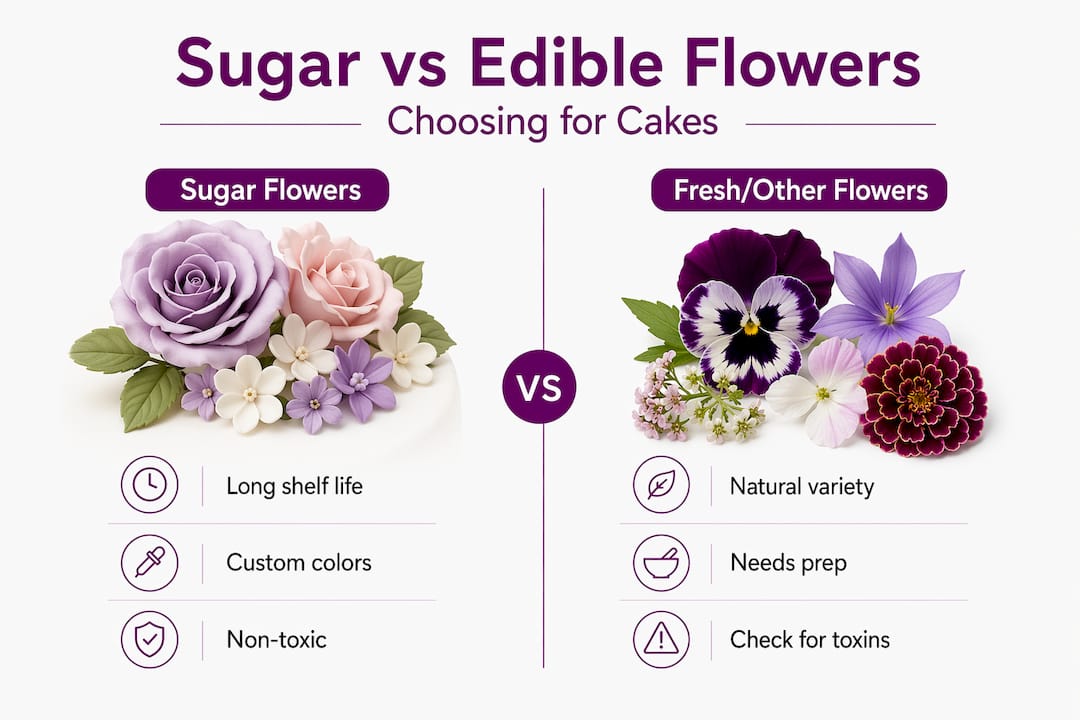
| Flower type | Skill level | Time required | Durability | Realism |
|---|---|---|---|---|
| Gum paste sugar flowers | Intermediate to advanced | High | Very high | Very high |
| Buttercream flowers | Beginner friendly | Moderate | Low to moderate | Moderate |
| Crystallised edible flowers | Beginner | Low | High (months) | Natural |
Here is a quick breakdown of each approach:
- Gum paste sugar flowers are wired, dry hard, and can be made weeks ahead. They are the most realistic, most durable, and require the most equipment and practice.
- Buttercream flowers are piped onto small squares of parchment paper, frozen solid, and then placed directly onto the cake. Buttercream flowers are brilliant for beginners because you can pipe a batch in advance, freeze them, and handle them with ease on the day.
- Crystallised edible flowers are fresh, pesticide-free blooms coated in lightly beaten egg white and caster sugar, then left to dry for 12 to 36 hours until crisp. They look genuinely beautiful and can be stored for months in an airtight tin.
For more ideas on how to use edible flower options across different cake styles, we have a whole article on the topic worth bookmarking.
Safety considerations and selecting the right flowers for cakes
This section matters more than most people realise, and it applies whether you are using fresh flowers or crafting sugar ones. If you are incorporating any natural element into a cake, you need to think carefully.
Florist flowers are frequently pesticide-treated and must never touch cake surfaces unless they come with certification confirming they are both edible and pesticide-free. Even then, you should do your own verification.
When selecting fresh or crystallised flowers for your wedding cakes, follow these rules:
- Avoid lilies, foxgloves, sweet peas, and daffodils. All are toxic and should never contact food.
- Choose roses, violets, pansies, lavender, and chamomile, sourced specifically as pesticide-free edible flowers.
- Never assume a flower is safe simply because it grows in your garden. Many common garden plants are toxic to varying degrees.
- Buy from a specialist supplier who clearly labels flowers as food-safe and edible, not just from a florist.
- The word “edible” and the phrase “food-safe” are not the same thing. An edible flower is safe to eat in small amounts. A food-safe flower means it will not contaminate anything it touches, but is not necessarily meant to be eaten.
“Just because a flower is listed as edible does not mean it is automatically safe for direct contact with wedding cake. Verification is always the decorator’s responsibility.”
We have a practical guide on selecting safe flowers for cakes if you want to explore this further.
Pro Tip: When in doubt, use sugar flowers. A beautifully crafted gum paste rose carries zero food safety risk and looks just as stunning as any fresh bloom.
Storing and preparing sugar flowers before cake assembly
One of the most exciting things about sugar flowers is how far ahead you can make them. This is genuinely a game-changer for anyone baking a wedding cake, where timing and stress levels are always a factor.
Sugar flowers can be made weeks or months in advance, provided they are completely dry and stored correctly. Here is how to do it properly:
- Dry completely before storing. A petal that feels dry on the surface may still have a soft core. Leave flowers an extra day longer than you think is necessary.
- Layer with tissue paper. Place finished flowers in a sturdy cardboard box, with tissue paper gently folded between each layer to prevent breakage.
- Store in a cool, dry location. A shelf in a spare room is ideal. Avoid kitchens (too much humidity) and avoid fridges (condensation will soften the paste and ruin the surface finish).
- Crystallised flowers need 12 to 36 hours to crisp up and can then be stored airtight for months, making them one of the easiest make-ahead decorations available.
Building your sugar flowers in batches over several weeks also means you avoid the frantic last-minute push. Make a few roses in week one, leaves in week two, and smaller filler flowers in week three. By the time the cake needs decorating, you have a full garden ready to arrange.
Learning opportunities and workshops to improve your sugar flower skills
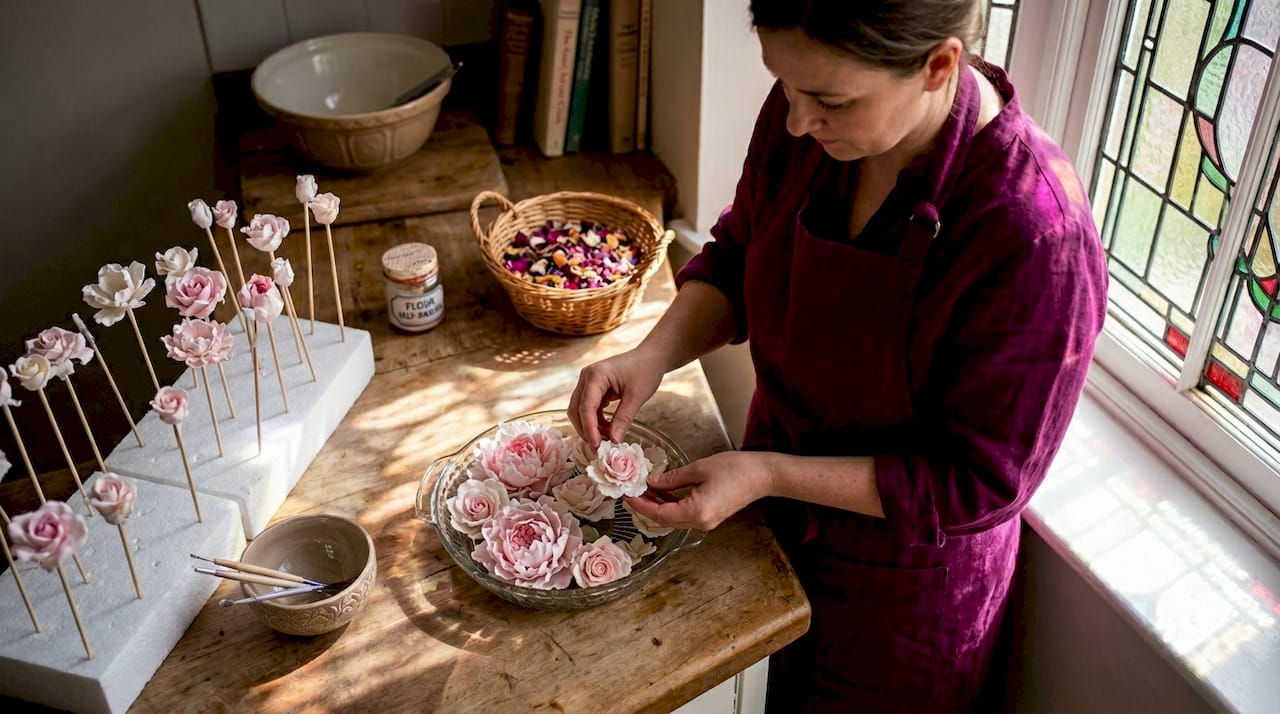
Self-teaching through sugar flower tutorials and online videos will take you a long way. But nothing accelerates skill development quite like spending time in a room with an expert, your hands in paste, making mistakes in real time and getting immediate feedback.
If you are based in South Wales, dedicated local sugar flower workshops can be harder to find, but there are excellent UK options worth travelling for or booking online:
- Multi-day UK workshops cover everything from wiring and shaping to colouring and advanced assembly. The Botanical Cake Studio’s 2-day sugar flower workshop is a brilliant example, running at £495 for May 2026 and teaching professional-level techniques intensively.
- Online sugar flower tutorials from experienced UK cake artists allow you to learn at your own pace, rewatch tricky steps, and build skills between workshop bookings.
- Local cake clubs and decorating communities in Wales often organise demonstration evenings where experienced members share techniques informally.
The investment in a workshop pays for itself quickly. You avoid months of self-taught trial and error, and you come home with both the techniques and the confidence to tackle ambitious projects.
The art and craft of sugar flowers: a baker’s perspective
Here is something we genuinely believe at The Vanilla Valley, and it comes from years of watching bakers of all levels: most people give up on sugar flowers too early, and almost always for the same reason. They start without the right tools.
Tool readiness matters as much as technique for success with sugar flowers. You can watch every tutorial available and still struggle if you are using a blunt cutter, the wrong gauge wire, or a foam pad that is too hard. The tools are not optional extras. They are half the craft.
There is also something worth saying about drying. Properly dried petals, curved naturally over formers, create the illusion that the flower was just picked from the garden five minutes ago. A flat-dried petal, even a perfectly shaped one, looks like a cake decoration. A naturally curved, fully dry petal looks like a flower. That difference is almost entirely in how you dry it, not how skilled you are.
The safety point is just as important and often overlooked. Calling a flower “edible” does not make it automatically food-safe for use on a cake. Decorators carry that responsibility, and it is worth taking seriously, especially on a wedding cake where many people are eating.
Our advice? Start with a simple five-petal flower in a single colour. Get the process right before you start worrying about multi-tone shading or complex roses. Confidence builds with every flower you make, and the skills stack on each other quickly once the basics are solid. Explore our sugar flower making insights for more inspiration when you are ready to level up.
Shop cake decorating supplies and sugarcraft in Cardiff
Ready to get started? The Vanilla Valley has everything you need to begin your sugar flower journey, right here in Cardiff.
Whether you need gum paste, floral wires, petal cutters, veiners, foam pads, or floral tape, our North Cardiff shop stocks a brilliant range of sugarcraft essentials alongside expert advice from a team who actually loves this stuff. We have been helping South Wales bakers since 2009, and nothing makes us happier than seeing a customer walk out with the tools to create something beautiful. Visit The Vanilla Valley online or in store for your cake decorating supplies, and let us help you find exactly what you need for the project ahead.
Frequently asked questions
What is the difference between gum paste and fondant for making sugar flowers?
Gum paste dries completely hard and can be rolled very thin for delicate, structured petals, while fondant stays soft and pliable, making gum paste the far better choice for realistic sugar flowers.
Can I use fresh flowers from my garden on a wedding cake?
Most fresh flowers are pesticide-treated or toxic and should not contact cakes unless certified edible and pesticide-free. Always verify safety before use.
How long does it take to dry sugar flowers before assembling?
Petals should be hard and not floppy before assembly, which typically means leaving them several hours to overnight depending on thickness and humidity.
Can I prepare sugar flowers well in advance of a wedding?
Yes. Fully dried sugar flowers can be stored in a cool, dry place for weeks or even months, layered carefully between tissue paper to prevent breakage.
Are piped buttercream flowers a good alternative for beginners?
Absolutely. Buttercream flowers piped onto parchment and frozen before placing on the cake are one of the most beginner-friendly methods available, with great results for the effort involved.