Transform birthday cakes with stunning edible flower designs
TL;DR:
- Many edible flowers used for birthday cakes are toxic or pesticide-treated, making knowledge essential for safety. Choosing certified organic, food-safe flowers like pansies, roses, and violets is crucial, while avoiding lilies, daffodils, and eucalyptus. Proper sourcing, handling, arranging, and allergy awareness ensure beautiful, safe, and flavorful floral cake decorations.
There’s something genuinely magical about a birthday cake crowned with real flowers. But here’s the thing most bakers don’t realise until it’s too late: a huge number of flowers used on celebration cakes are either toxic, pesticide-laden, or simply not food-safe at all. The gap between a stunning floral cake and a safe one comes down to knowledge, not talent. Whether you’re a home baker wanting to impress at your next family gathering or a professional decorator building your signature style, this guide covers everything you need to know about choosing, prepping, and arranging edible flowers with confidence.
Table of Contents
- Choosing safe edible flowers for birthday cakes
- Preparing edible flowers: Sourcing and handling for food safety
- Arranging and attaching flowers: Professional mechanics
- Common pitfalls and allergy risks: What every baker should know
- Candying and infusing edible flowers: For durability and flavour
- Why edible flowers transform birthday cakes: Beyond aesthetics
- Enhance your cake creations with expert supplies
- Frequently asked questions
Key Takeaways
| Point | Details |
|---|---|
| Safety first | Always select organic, pesticide-free edible flowers and verify their safety before decorating your cake. |
| Preparation matters | Proper washing and removal of stems and pollen minimises health risks and ensures best flavour. |
| Stunning arrangements | Layer flowers creatively using professional mechanics for maximum beauty and cake durability. |
| Avoid common mistakes | Be cautious with strong flavours, wilt-prone blooms, and potential allergens. |
| Enhance durability | Candying and flavour infusions prolong edible flower freshness and deliver unique tastes. |
Choosing safe edible flowers for birthday cakes
Let’s start with the most important question: which flowers are actually safe to eat? It’s surprisingly easy to get this wrong. Many beautiful blooms sold by florists are treated with systemic pesticides that cannot be washed off, and some common garden flowers are downright dangerous even in small amounts.
The good news is that there are plenty of gorgeous options that are genuinely food-safe. Safe edible flowers include pansies, violas, roses, lavender, calendula, dahlias, hibiscus, borage, nasturtium, and violets, all selected for their mild flavours, colour variety, and durability on cakes. These flowers look absolutely stunning on frosted sponges, and each one brings its own personality to a design.
Now compare that with what you must avoid. Lilies, daffodils, foxglove, and eucalyptus are all visually beautiful but genuinely dangerous. Lily pollen alone can cause serious harm. Baby’s breath, a staple in florist bouquets, is also on the “never on a cake” list.
| Flower | Edible? | Notes |
|---|---|---|
| Pansy | Yes | Mild, slightly grassy flavour |
| Rose | Yes | Sweet and fragrant; remove bitter white base |
| Nasturtium | Yes | Peppery; adds colour and flavour |
| Lavender | Yes | Use sparingly; very strong flavour |
| Calendula | Yes | Earthy, slightly bitter; vibrant orange |
| Lily | No | Highly toxic; avoid entirely |
| Baby’s breath | No | Mildly toxic; not food-safe |
| Daffodil | No | Toxic even on contact |
| Tulip | Caution | Edible but allergenic for some; remove pollen |
Before placing any flower on a cake, run through this quick checklist:
- Is it certified organic and pesticide-free?
- Can you confirm the exact variety (not just the general family)?
- Was it sourced from a food-safe supplier rather than a florist?
- Have you removed stems, stamens, and any bitter parts?
- Is the guest list free of known plant or pollen allergies?
If you’re looking for more ways to use safe botanicals in your designs, explore these creative edible flower ideas for spring celebrations and parties. And if you’re thinking ahead to the festive season, you might be surprised how well edible botanicals work in festive edible decorations too.
Preparing edible flowers: Sourcing and handling for food safety
Choosing the right flowers is only half the battle. How you source and handle them before they even touch the cake matters enormously. This is where a lot of well-meaning bakers slip up.
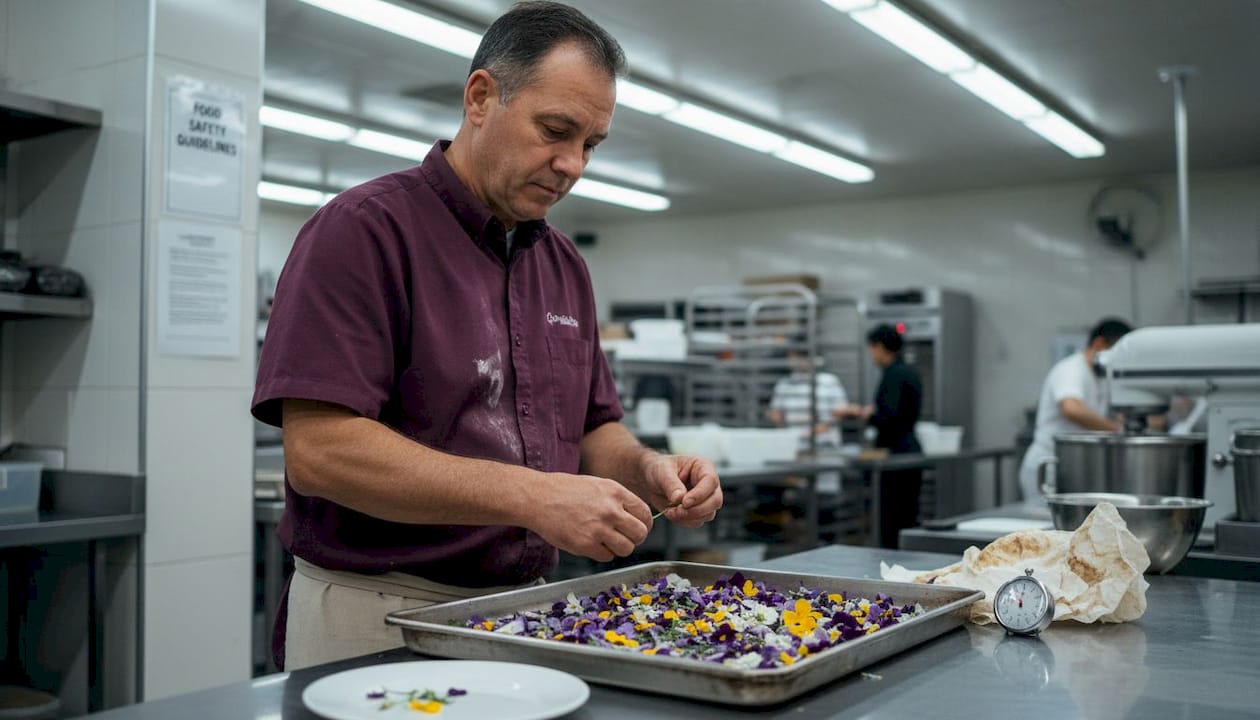
Preparation guidance is clear: source organic, pesticide-free flowers from farmers markets, specialist food suppliers, or grow your own. Gently rinse under cool water, pat dry with kitchen paper, remove bitter stems, stamens, and the calyx (the green leaf-like base of the bloom), and use them on the same day where possible. If you must refrigerate, keep them loosely wrapped in damp kitchen paper and use within 24 hours.
Here’s a step-by-step process to follow every single time:
- Source your flowers from a certified organic grower or a reputable specialist food supplier, not a florist or supermarket flower display.
- Inspect each bloom carefully for insects, bruising, or signs of disease. Discard anything that looks damaged.
- Rinse gently under cool running water. Don’t soak, as this can cause petals to bruise and become translucent.
- Pat completely dry using clean kitchen paper or a soft cloth. Any moisture left on petals will transfer to your frosting and cause smearing.
- Remove non-edible parts: stems, stamens, pistils, and the calyx should all come off before a flower goes anywhere near a cake.
- Store correctly in a single layer between sheets of damp kitchen paper inside a sealed container in the fridge if you’re not using them immediately.
- Arrange at the last moment before serving for best freshness and appearance.
Florist flowers are an absolute no-go, by the way. Systemic pesticides used on commercially grown cut flowers penetrate the entire plant, meaning they cannot be removed by rinsing. These chemicals survive on petals and can transfer directly to cake surfaces.
Pro Tip: Try to arrange edible flowers on your cake as close to serving time as possible. Even the most robust edible flowers begin to lose colour and texture within a couple of hours at room temperature.
For more ideas on handling delicate edible decorations, check out our guide on preparing edible decorations including edible gold leaf.
Arranging and attaching flowers: Professional mechanics
Right, your flowers are prepped and ready. Now the real creative fun begins. Getting the arrangement to look effortless is actually a skill that takes a little practice, but the principles are easy to follow.
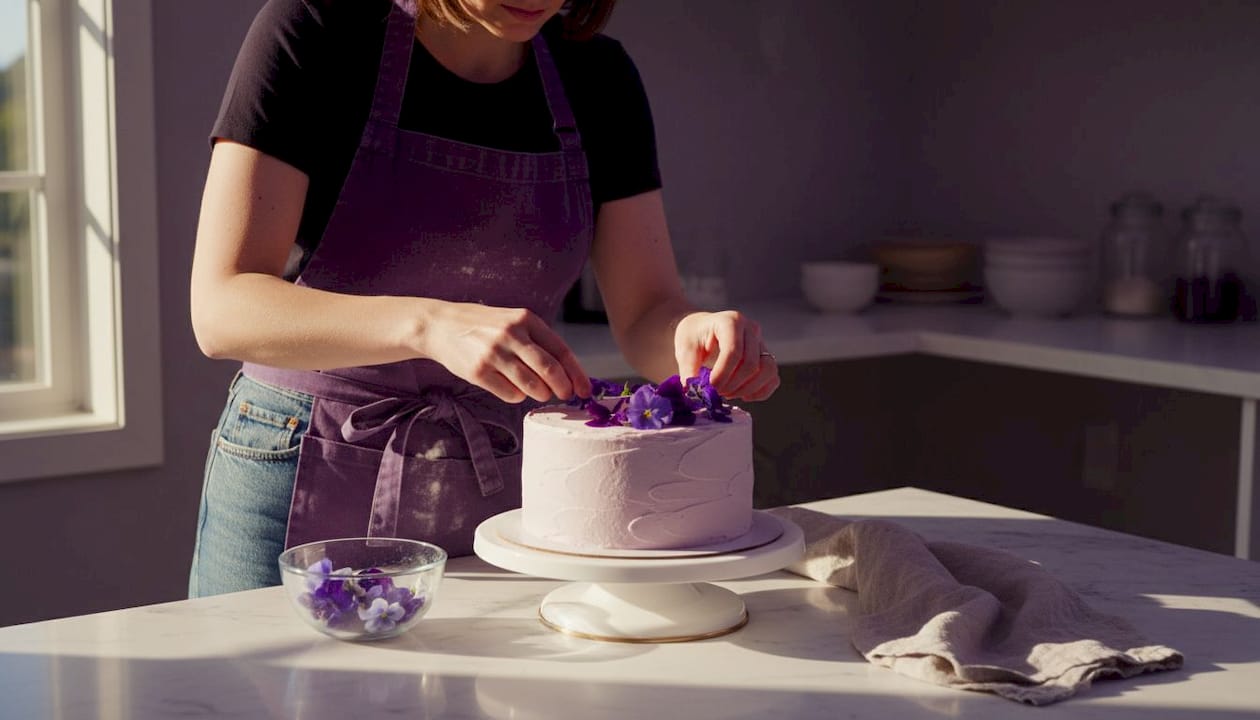
Start with your larger blooms and work inward. Layering technique involves gently pressing fresh flowers into soft frostings like Swiss meringue buttercream, placing larger blooms first and filling gaps with smaller ones, using tweezers for precision, and matching flower colours to your frosting palette for a cohesive result. Scattered petal confetti on the sides of the cake can also hide imperfections and add a dreamy, organic finish.
Here are some key arrangement principles:
- Work with odd numbers. Groups of three or five flowers always look more natural than even pairs.
- Vary heights. Use flower picks or folded parchment to lift some blooms slightly above others for dimension.
- Embrace negative space. Professionals know that a few well-placed flowers on a clean white buttercream can look more premium than a packed arrangement.
- Match flavour as well as colour. Tart hibiscus pairs beautifully with rich chocolate, whilst floral cake arrangement principles suggest lavender works best against lemon or vanilla.
When it comes to stems, you must always use a physical barrier. Even food-safe edible flowers can have stems that carry sap which is mildly bitter or irritating. Wrap stems in food-grade floral tape and insert them into parchment-lined posy picks or clean drinking straws before pressing into the cake. Never let a bare stem make direct contact with your frosting.
| Flower type | Recommended method |
|---|---|
| Small blooms (pansies, violas) | Press directly into soft frosting with tweezers |
| Medium blooms (roses, calendula) | Use parchment-lined posy picks for stem support |
| Larger blooms (dahlias, hibiscus) | Trim stems short; support with toothpick and parchment wrap |
| Loose petals | Scatter directly onto frosting surface |
Pro Tip: Use fine-tipped kitchen tweezers when placing small flowers. It gives you far more precision than fingers and keeps the frosting around each bloom perfectly smooth.
Common pitfalls and allergy risks: What every baker should know
Even experienced decorators run into trouble with edible flowers. Knowing the common pitfalls before they happen is what separates a good cake from a great one.
Wilting is the most frequent problem. Flowers wilt quickly at room temperature, especially in warm kitchens or during summer celebrations. Using a soft, non-crusting frosting like Swiss meringue buttercream rather than a stiffer American buttercream helps enormously, as wilting prevention depends on the flower having a slightly moist surface to hold against.
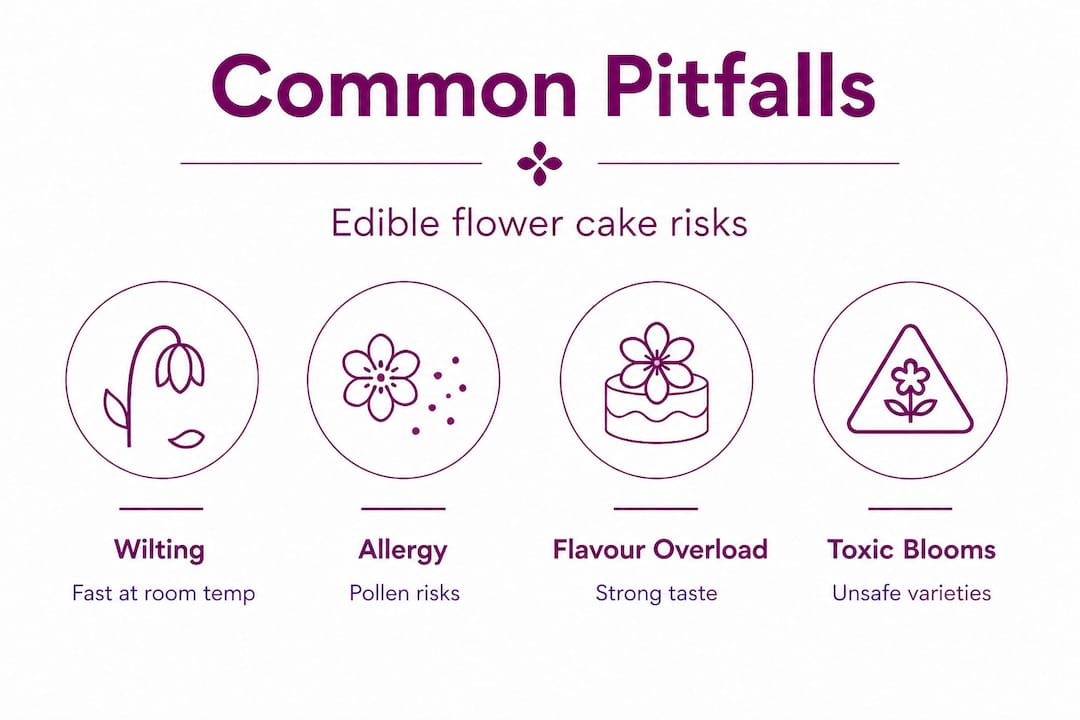
Flavour overload is real. Lavender is one of the most popular choices for floral cakes, but use even a petal too many and the whole cake tastes like soap. The same goes for chrysanthemums. Use these stronger-flavoured blooms very sparingly, or infuse them into the frosting instead of placing them whole on top.
Pollen and allergen risks are something every baker should flag clearly. Guests with hay fever or pollen sensitivities can react to open-centred flowers even without eating them directly. Pollen allergens in flower centres can cause reactions ranging from mild irritation to more serious responses. Always remove stamens from open blooms before use, and always inform guests that edible flowers are present on the cake.
Social media trends don’t always come with safety instructions. The California-style organic floral cake aesthetic is wildly popular right now, featuring loose, garden-gathered blooms arranged in a beautifully casual way. But hygiene and safety concerns are growing alongside the trend’s popularity, particularly for wedding and birthday cakes where guests may not expect or be aware of allergens.
Before you bake for a crowd, run through this safety checklist:
- Confirm all flowers are certified organic and pesticide-free.
- Remove all stamens, pistils, and stems before use.
- Inform guests verbally or via a small card that edible flowers are present.
- Ask about pollen or plant allergies when catering for a party.
- Avoid heavily scented varieties if guests are allergy-prone.
For more ideas on celebrating with seasonal designs, browse our guides on trendy birthday cake styles and decoration themes for cakes that’ll keep your celebrations looking incredible and safe.
Candying and infusing edible flowers: For durability and flavour
If you want your floral decorations to last longer and look absolutely polished, candying is the technique to learn. It’s one of those skills that feels fiddly the first time but quickly becomes a satisfying ritual.
Candied flowers are coated in egg white and caster sugar, then dried until crisp. They last for days at room temperature and hold their colour beautifully. Here’s how to do it:
- Brush each clean, dry petal or whole flower lightly with a thin layer of pasteurised egg white using a soft food-safe brush.
- Dust immediately and generously with caster sugar, turning the flower so all sides are coated evenly.
- Place on a baking sheet lined with parchment and leave to dry at room temperature for 12 to 24 hours, or in a very low oven (around 50°C) for two to three hours.
- Store in an airtight container layered with parchment paper. They’ll keep for up to a week in dry conditions.
- Arrange on your cake once fully dried. Candied flowers are rigid and hold their shape beautifully even on a buttercream surface.
For amateur bakers, starting with pre-packaged organic edible flower mixes is a brilliant shortcut. Practise candying individual petals before moving on to whole blooms. For professionals, the real magic comes from infusing flower flavours directly into your frostings or syrups to create layered taste experiences that match the visual decoration on top.
Pro Tip: In humid conditions, candied flowers may not dry fully at room temperature. Pop them in a food dehydrator at a low setting for consistent results every time, regardless of the weather outside.
For more advanced sugar work inspiration, our guide to candying edible flowers for wedding cakes is a wonderful next step. And if you’re excited about what’s trending in floral cake decoration right now, our spring edible flower trends feature is full of fresh ideas.
Why edible flowers transform birthday cakes: Beyond aesthetics
Here’s something we genuinely believe at The Vanilla Valley: the bakers who approach edible flowers purely as a visual trick are missing the bigger picture entirely.
Yes, a dahlia-crowned layer cake looks extraordinary. Yes, scattered pansies on a buttercream finish will earn every bit of the praise it gets. But the real shift that edible flowers bring to cake decorating is the elevation of food as an experience, not just a display. When you treat flowers as ingredients, matching their flavour profiles to your sponge and frosting with the same care you’d give to chocolate and raspberry, the result is something entirely different from a “pretty cake.” It becomes a cohesive, thoughtful creation.
We also think the safety conversation is badly overdue. Too many bakers underestimate the risks, and too many tutorials online simply don’t address them at all. Working with current cake design trends is exciting and worth embracing wholeheartedly, but doing so responsibly is what earns long-term trust from your clients and loved ones.
Safety doesn’t limit creativity. It focuses it. When you know exactly which flowers you can use and how to use them properly, the creative possibilities actually expand. You stop second-guessing and start designing. That’s a brilliant place to be as a baker.
Enhance your cake creations with expert supplies
Ready to bring all of this to life in your own kitchen? At The Vanilla Valley, we’ve been supporting bakers across the UK since 2009, and we know how much the right supplies matter when you’re creating something special.
From beautiful cake boards and specialist frostings that hold floral arrangements perfectly, to food colours for matching your palette to your blooms, everything you need is in our cake decorating supplies shop. We also love sharing inspiration, so if you’re planning something for a summer celebration, our guide to spring wedding cake styles is packed with gorgeous ideas that’ll spark your next design. Whether you’re making your first floral birthday cake or your hundredth, we’re here to help you make it brilliant.
Frequently asked questions
Which flowers are safe to put on birthday cakes?
Safe choices include pansies, roses, violets, lavender, calendula, and nasturtium, but they must always be organic and pesticide-free to be truly food-safe.
How do I prepare edible flowers safely for cake decoration?
Gently rinse flowers in cool water, remove stems and stamens, and use only same-day organic blooms to prevent contamination or wilting on the cake.
Can edible flowers cause allergies or poisoning?
Yes, and it’s important to take this seriously. Toxic flowers like lilies and daffodils are dangerous even on contact, whilst pollen from open-centred blooms can trigger allergic reactions in sensitive guests.
How can I stop flowers from wilting on my cake?
Use a soft, non-crusting frosting and arrange flowers as close to serving time as possible to keep them looking fresh and vibrant throughout the celebration.
Recommended
- Creative cupcake decorating ideas for spring parties - The Vanilla Valley
- Easy last-minute birthday cake decoration ideas: 5 quick wins - The Vanilla Valley
- How to achieve a natural, elegant floral cake look - The Vanilla Valley
- Spring cake trends 2026: fresh ideas for every baker - The Vanilla Valley
- 7 formas creativas de usar papel comestible en cumpleaños