
Creative ways to use leftover Easter chocolate in baking
TL;DR:
- Leftover Easter chocolate can be used in various simple baking recipes like brownies, cookies, and rocky road.
- Proper melting techniques and storage ensure the chocolate maintains quality and prevents burning or seizing.
- Using a mix of chocolate types and keeping the process straightforward enhances flavor and fun in baking.
Every Easter, the same thing happens. The egg hunt ends, the wrapping paper hits the floor, and suddenly there’s a mountain of chocolate sitting on the kitchen counter. Some of it gets eaten straight away, but a surprising amount lingers for weeks. Rather than watching it go stale or feeling guilty about the waste, why not turn it into something genuinely delicious? From fudgy brownies to no-bake rocky road, leftover Easter chocolate is actually a brilliant baking ingredient. We’ve put together everything you need to know to use up every last bit creatively and confidently.
Table of Contents
- What you’ll need to start baking with leftover chocolate
- Easy ways to prepare leftover chocolate for baking
- Inventive recipes for leftover Easter chocolate
- Storage, freshness and handling older Easter chocolate
- Why simple bakes make leftover chocolate shine
- Discover more inspiration for Easter bakes
- Frequently asked questions
Key Takeaways
| Point | Details |
|---|---|
| Maximise leftover chocolate | Turn surplus Easter treats into delicious bakes and no-bake creations using simple techniques. |
| Safe, simple prep methods | Cut, melt and handle chocolate properly for best texture and flavour—avoid water and overheating. |
| Choose recipes wisely | Go for simple brownies, cookies or rocky road to suit your chocolate type and keep things fuss-free. |
| Don’t waste older chocolate | Slightly stale or bloomed chocolate is perfect for baking—even if it doesn’t look its best. |
What you’ll need to start baking with leftover chocolate
Now that you’re ready to tackle the chocolate mountain, here’s what you’ll need before you start.
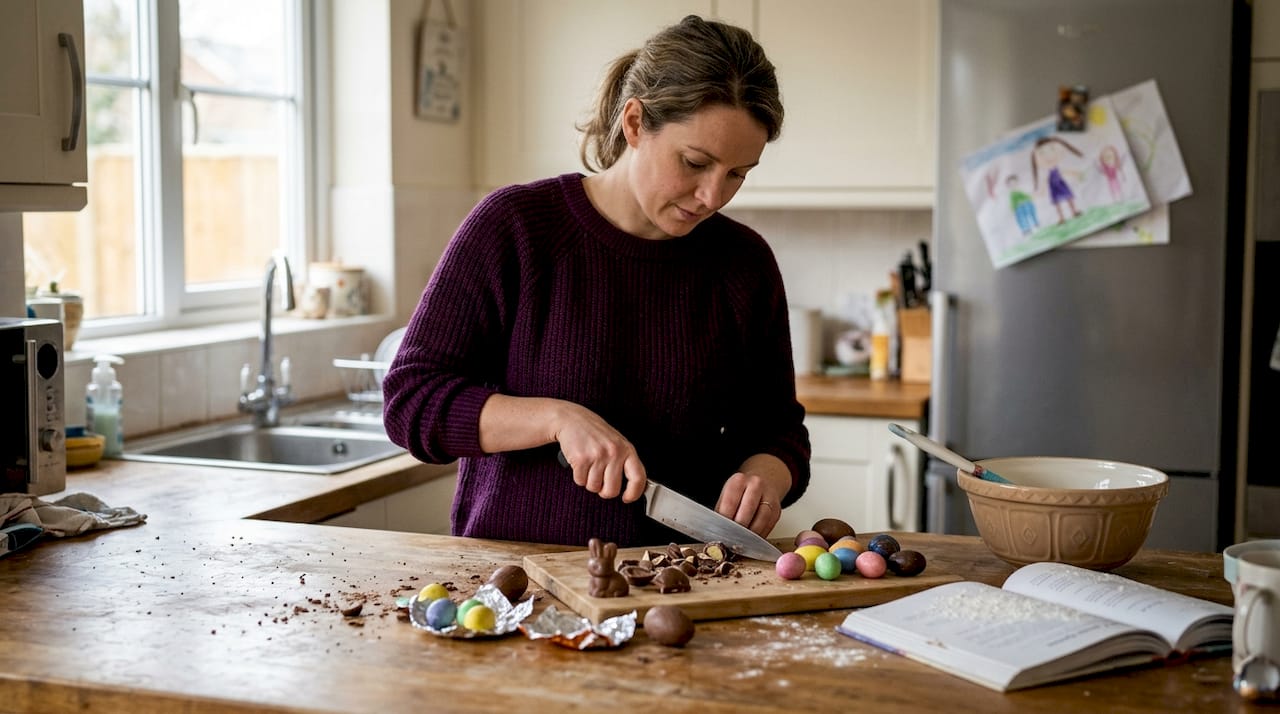
The good news is you probably already have most of what’s required. A sturdy chopping board and a sharp knife are your first essentials for breaking down larger Easter eggs into workable pieces. You’ll also want a microwave-safe bowl or a heatproof glass bowl for melting, a silicone spatula for stirring, and a couple of baking trays lined with parchment paper.
For ingredients beyond the chocolate itself, the basics cover most recipes:
- Plain flour (self-raising or plain depending on the recipe)
- Caster sugar or soft brown sugar
- Eggs (medium, at room temperature)
- Butter (unsalted works best for baking)
- A pinch of salt and vanilla extract
- Optional mix-ins: nuts, dried fruit, biscuits, or mini marshmallows
One thing worth knowing before you start is that not all chocolate behaves the same way in the oven. You can chop Easter chocolate into chunks for mix-ins in brownies, cookies, cakes, and muffins, or melt it down for batters, frostings, ganache, and no-bake treats like rocky road. The method you choose often depends on the type of chocolate you’re working with.
Here’s a quick comparison to help you decide:
| Chocolate type | Best use | Melting behaviour | Flavour profile |
|---|---|---|---|
| Milk chocolate | Chips, chunks in cookies | Melts quickly, can scorch | Sweet, creamy |
| Dark chocolate | Batters, ganache, brownies | Melts smoothly, more stable | Intense, slightly bitter |
| White chocolate | Swirling, chips, decoration | Burns easily, needs low heat | Very sweet, vanilla notes |
If you’ve ended up with a mix of all three, don’t worry. Combining types actually adds complexity to your bakes. We love the idea of mixing milk and dark together in a brownie batter for a richer result. For more ideas on how different chocolates work in fillings and coatings, our guide to chocolate types for ganache is a great read.
Pro Tip: If your Easter haul includes filled eggs or truffles, set those aside for eating and use the solid hollow eggs for baking. They melt more evenly and give you cleaner results.
You might also want to check out our treat box ideas if you’re thinking about gifting some of your bakes once they’re done.
Easy ways to prepare leftover chocolate for baking
With tools and ingredients assembled, the next step is preparing your chocolate correctly.
Getting this stage right makes a real difference to the finished bake. Poorly melted chocolate can turn grainy, seize up, or burn, and that affects both flavour and texture. The good news is it’s easy to avoid with a little care.
Here’s a simple step-by-step process:
- Chop uniformly. Break your chocolate into roughly equal-sized pieces. This ensures everything melts at the same rate and prevents some bits burning while others stay solid.
- Choose your method. A double boiler (a heatproof bowl set over a pan of barely simmering water) gives you the most control. Alternatively, use a microwave in 20 to 30 second bursts on medium power.
- Stir frequently. Whether you’re using a double boiler or microwave, stir between each burst or every minute or so. This distributes heat evenly.
- Avoid water contact. Even a single drop of water can cause chocolate to seize and turn lumpy. Make sure your bowl and spatula are completely dry.
- Don’t overheat. Chocolate should feel just warm to the touch, not hot. If it’s steaming, it’s too hot.
As a general rule, melt using short bursts and stir frequently to avoid seizing or burning, always chopping uniformly first and keeping water well away from the bowl.
“The biggest mistake people make is rushing the melt. Low and slow is always the way to go with chocolate.”
If your chocolate does seize and turns thick and grainy, don’t panic. Add a small teaspoon of neutral oil or a knob of butter and stir gently. It usually comes back together beautifully. This is especially useful when working with older Easter chocolate that may have dried out slightly.
For a deeper look at technique, our chocolate melting tips guide covers everything in detail, and if you want to try something more advanced, our article on tempering chocolate is worth a read.
Pro Tip: Freeze your chopped chocolate chunks for 15 minutes before folding them into cookie dough or muffin batter. They hold their shape better during baking and give you those satisfying pockets of melted chocolate in every bite.
Inventive recipes for leftover Easter chocolate
With chocolate prepped, it’s time to turn it into irresistible bakes.
The beauty of leftover Easter chocolate is its variety. You’ve got milk, dark, white, caramel-filled, crispy-centred, and everything in between. That mix is actually an asset in the kitchen.
Fudgy brownies are the classic starting point. Mix dark or milk chocolate into your batter for depth, and scatter chunks of a different type on top before baking. Triple chocolate brownies typically bake in 20 to 30 minutes and yield 12 to 24 servings depending on how you cut them. Chilling the tray for an hour after baking gives you that dense, fudgy texture everyone loves.
Cookies and muffins are wonderfully forgiving. Fold chunks directly into the dough or batter without melting. Add chopped walnuts, dried cranberries, or a sprinkle of sea salt on top for contrast. The chunks stay slightly gooey inside and create brilliant texture.

No-bake rocky road is the easiest option of all. Melted chocolate combined with biscuits and mix-ins like marshmallows, glacé cherries, or dried fruit sets into a traybake that requires zero oven time. It’s brilliant for getting kids involved too. Check out our baking with kids guide for more family-friendly ideas.
Here’s a quick comparison of popular recipes to help you choose:
| Recipe | Prep and bake time | Difficulty | Servings |
|---|---|---|---|
| Fudgy brownies | 45 to 55 minutes | Easy | 16 squares |
| Chocolate chip cookies | 30 to 40 minutes | Easy | 18 to 24 cookies |
| No-bake rocky road | 15 minutes plus setting | Very easy | 12 to 16 bars |
| Chocolate muffins | 35 to 45 minutes | Easy | 12 muffins |
For something a little more showstopping, our Easter egg cheesecake guide is absolutely worth exploring. And if you want to go all out on decoration, our cake decorating ideas article is full of creative inspiration.
- Use a mix of chocolate types for more interesting flavour
- Don’t overbake brownies, they firm up as they cool
- Rocky road sets faster in the fridge than at room temperature
- Taste your chocolate before baking so you know how sweet it is
Storage, freshness and handling older Easter chocolate
After your bake, or if you have more to use up, here’s how to make the most of remaining chocolate.
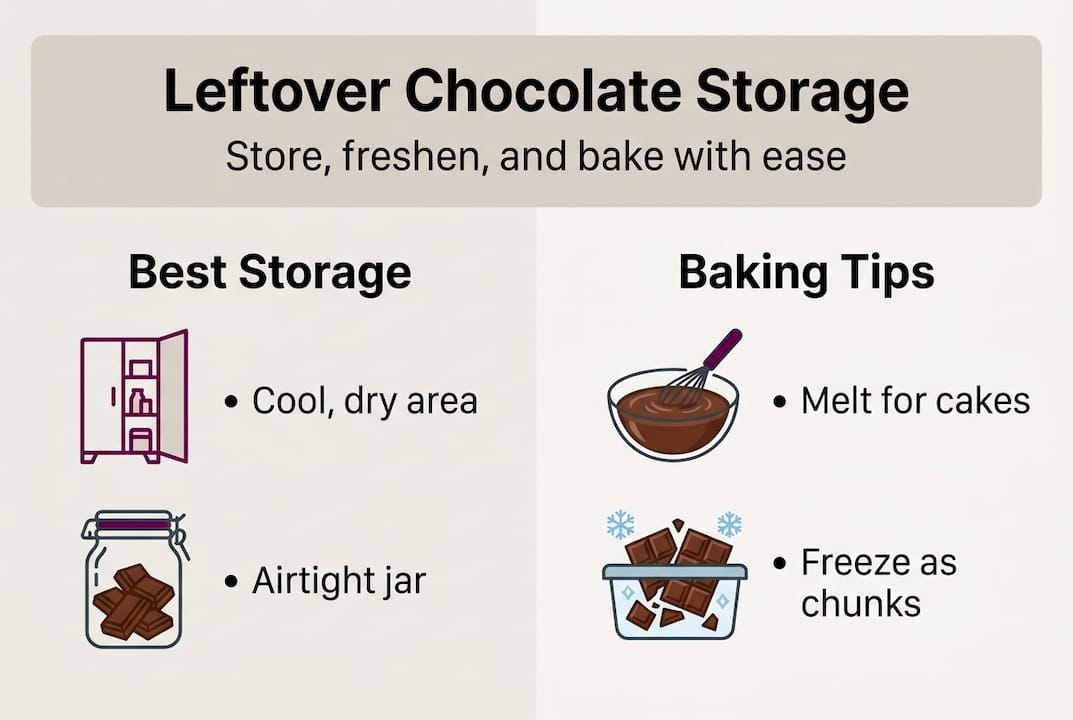
Chocolate is surprisingly resilient when stored correctly. The ideal conditions are a temperature between 16 and 20 degrees Celsius with low humidity. Avoid the fridge if you can, as condensation causes bloom and can affect texture. A cool, dark cupboard away from strong-smelling foods is perfect.
Before using any leftover chocolate in baking, it’s worth doing a quick freshness check:
- Visual check: Look for a white or grey coating (bloom) or any mould. Bloom is harmless. Mould is not.
- Smell check: Good chocolate smells sweet and cocoa-rich. A rancid, sour, or off smell means it’s past its best.
- Texture check: Some dryness or slight crumbling is fine for baking. Extreme grittiness may affect the finished result.
- Taste check: A small nibble will tell you a lot. If it tastes fine, it’ll bake fine.
As a rule, store chocolate between 16 and 20 degrees at low humidity, and use older chocolate in baking as long as there’s no mould or off smell, since texture changes are safe and largely unnoticeable once baked.
Older chocolate that’s gone a little dry or crumbly is actually brilliant for baking. The heat and moisture from the batter revive it completely. You’d never know the difference in a finished brownie or cookie.
Pro Tip: If you have more chocolate than you can use in the next few weeks, chop it into chunks and freeze in a zip-lock bag. It keeps well for up to three months and goes straight from freezer to batter without any issues. Our melting chocolate guidelines cover how to handle frozen chocolate safely.
Why simple bakes make leftover chocolate shine
Here’s something we genuinely believe at The Vanilla Valley: the best thing you can do with leftover Easter chocolate is keep it simple.
There’s a temptation, especially if you’ve been browsing beautiful baking content online, to reach for the most complex recipe you can find. But complicated techniques often require precise chocolate ratios and specific cocoa percentages. Leftover Easter chocolate rarely fits those specs neatly.
Simple chop-and-stir methods actually preserve what makes Easter chocolate special. Those familiar shapes, the crispy rice centres, the caramel pockets, they become a feature rather than disappearing into a batter. A rocky road where you can still spot a recognisable chocolate chunk is far more joyful than a technically perfect mousse.
There’s also something lovely about the process itself. Baking with leftover Easter chocolate is playful and forgiving. It’s a brilliant activity to share with children, and it extends the Easter fun well beyond the egg hunt. Our creative mini egg cakes article shows just how much personality you can bring to simple bakes with a little imagination.
Don’t overthink it. Just bake.
Discover more inspiration for Easter bakes
If you’re ready to take your baking further, you’ll find even more inspiration and tools within easy reach.
At The Vanilla Valley, we’ve been helping bakers of all levels create amazing things since 2009, and Easter is one of our favourite times of year. Whether you need cake boards, decorations, sprinkles, or food colours to finish off your Easter bakes beautifully, our decorating supplies shop has everything you need in one place.

We also have a brilliant collection of recipe articles and baking guides to keep the creativity going. If you loved the idea of using up your Easter haul in style, our mini egg cake inspiration guide is a fantastic next read. Free delivery options, next day dispatch, and a loyal community of bakers make us the go-to spot for everything you need to bake brilliantly.
Frequently asked questions
Can I use chocolate that’s gone cloudy or has white spots?
Yes, this is called chocolate bloom and it’s completely safe to eat and bake with. Baking masks any texture changes, so your finished bake will taste just as good. Old chocolate is safe to use as long as there’s no mould or off smell.
Do I need to temper leftover Easter chocolate before using it in baking?
No, tempering is only necessary if you want a glossy, snappy finish for decorations or dipped sweets. Standard baking processes melt and reset the chocolate regardless, so you can skip this step entirely. Melting in short bursts with frequent stirring is all you need.
What’s the easiest recipe for using up lots of leftover chocolate?
No-bake rocky road bars are the simplest option by far. You just melt the chocolate, stir in broken biscuits and your chosen mix-ins, press into a tray, and chill. Melted chocolate with biscuits and mix-ins requires minimal skill and barely any equipment.
How can I stop chocolate chips from melting completely in cookies?
Milk and white chocolate hold their shape better than dark when baked. Freezing your chopped chunks for 15 minutes before adding them to the dough makes a real difference and helps them keep those satisfying pockets of chocolate throughout the bake.