How to achieve a natural, elegant floral cake look
TL;DR:
- Creating natural-looking floral cakes requires proper tools, natural ingredients, and tasteful arrangements.
- Practice, patience, and restraint, including use of negative space, lead to elegant, realistic designs.
- Using stable buttercream, natural colorants, and thoughtful placement ensures professional results.
There is nothing more frustrating than spending hours on a floral cake, only to step back and find it looks stiff, artificial, or just a bit too much. That gap between the graceful, garden-fresh cakes you admire and what actually comes out of your kitchen is a challenge we hear about all the time. The good news? It is absolutely closeable. Whether you are baking for a weekend celebration or working towards professional commissions, this guide walks you through every stage of creating a truly natural, elegant floral cake, from gathering the right tools to placing your final petal with confidence.
Table of Contents
- Gathering your tools and ingredients for natural floral cakes
- Preparing your cake and base: foundation for elegance
- Mixing natural colours and making the perfect buttercream
- Arranging flowers for a truly natural and elegant effect
- Common mistakes and how to troubleshoot for a flawless finish
- Why true floral cake elegance is about restraint, not excess
- Where to find supplies for your next elegant floral cake
- Frequently asked questions
Key Takeaways
| Point | Details |
|---|---|
| Select the right base | A well-prepared sponge and crumb coat create the ideal foundation for natural floral designs. |
| Use natural colours | Fruit powders and botanical colourants make floral cakes look authentic and chemical-free. |
| Arrange with restraint | Asymmetry, negative space, and varied flower sizes are essential for an elegant finish. |
| Chill for stability | Working with chilled cakes and buttercream ensures piped flowers hold their shape beautifully. |
Gathering your tools and ingredients for natural floral cakes
Before a single petal is piped, you need the right kit. Working with the wrong nozzle or an unstable buttercream will undo even the most careful technique, so getting your setup right from the start matters enormously.
Essential tools to have ready:
- Piping bags (both disposable and reusable work well)
- Petal nozzles (numbers 101, 102, and 104 are the most versatile for floral work)
- A leaf nozzle (number 352 is a favourite)
- A turntable for smooth, controlled rotation
- A small offset spatula for spreading and smoothing
- Parchment paper for practice runs
- Flower nails for building individual blooms off the cake
These are not luxury items. They are the basics that give you actual control. Without a turntable, for instance, you are fighting the cake rather than working with it.
Ingredients for a natural look:
The ingredients you choose shape the final aesthetic just as much as technique does. For buttercream flowers, you want unsalted butter at room temperature, icing sugar, and a small splash of cream for consistency. For colour, skip the neon artificial gels where possible. Fruit powders, such as freeze-dried raspberry, beetroot, or butterfly pea flower, produce the kind of soft, dusty hues that look genuinely botanical. You can also explore alternatives to artificial colourants if you want to keep things as natural as possible from start to finish.
For fresh edible flowers, naked cakes with thin crumb coat frosting and fresh edible flowers such as pansies, violets, and roses achieve that organic, elegant look beautifully. Asymmetrical patterns and greenery complete the picture. If you are curious about adding extra dimension, learning about using colour dusts is a brilliant next step.
Naked versus fully piped: which style suits you?
| Style | Appearance | Skill level | Best for |
|---|---|---|---|
| Naked cake with fresh flowers | Rustic, organic, light | Beginner to intermediate | Weddings, garden parties |
| Fully piped buttercream flowers | Polished, detailed, textured | Intermediate to advanced | Celebration cakes, commissions |
| Semi-naked with piped accents | Balanced, elegant | Intermediate | Versatile occasions |
Sourcing and handling edible flowers safely is non-negotiable. Only use flowers labelled specifically as edible and food-safe. Supermarket flowers and garden centre blooms are often treated with pesticides. Rinse edible flowers gently in cold water and pat dry on kitchen paper before use. Never place them directly on buttercream until you are ready to serve, as moisture can cause discolouration.
Pro Tip: Always double-check every flower variety for edibility before placing it on a cake. Some beautiful blooms, such as lily of the valley, are toxic. When in doubt, leave it out. You might also find inspiration in our guide to festive edible decorations for seasonal ideas.
Preparing your cake and base: foundation for elegance
Once you have all your ingredients ready, a well-prepared cake base is vital for an elegant finished look. Think of the cake itself as the canvas. A bumpy, crumbly, or warm surface will undermine everything you build on top of it.
Choosing your sponge:
Light vanilla or lemon sponges work beautifully for a delicate floral aesthetic. They let pale, soft colours sing. Chocolate sponge, on the other hand, creates a striking contrast when paired with blush or ivory buttercream flowers. Neither is wrong. It simply depends on the mood you want to create.
Preparing the cake step by step:
- Bake your sponge layers and allow them to cool completely before touching them. Warm cake melts buttercream instantly.
- Level each layer using a serrated knife or cake leveller for a flat, even stack.
- Fill between layers with a generous but not excessive amount of buttercream, then press gently to secure.
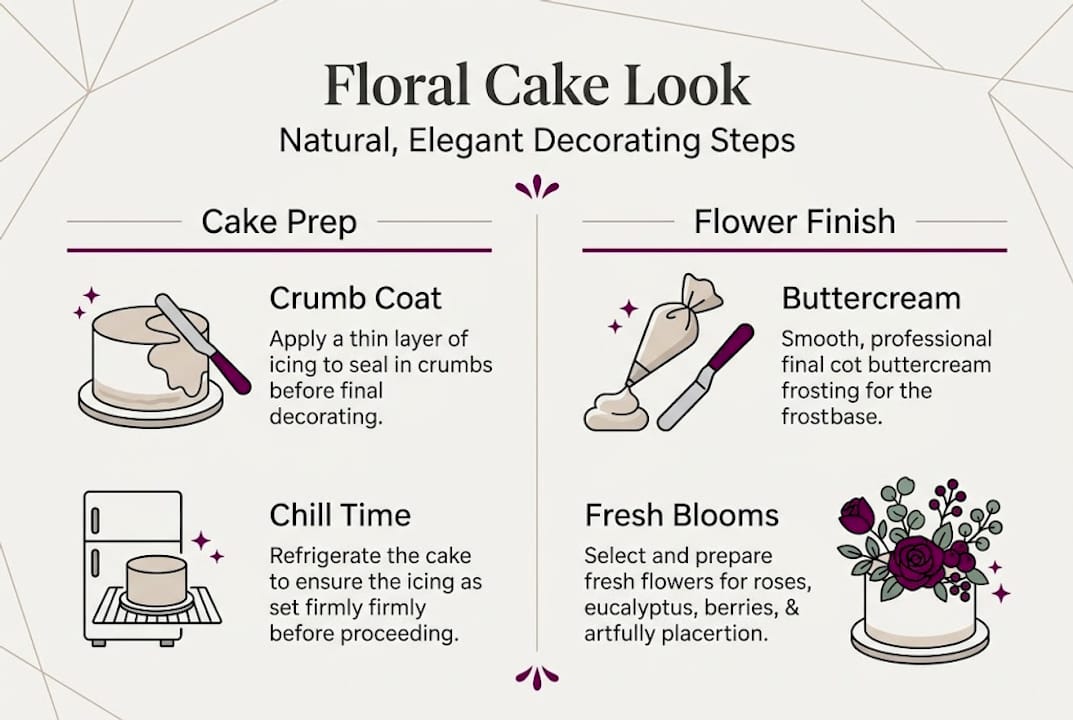
- Chill the filled cake in the fridge for at least 30 minutes before crumb coating.
- Apply your crumb coat: a thin, even layer of buttercream that seals in crumbs. For a naked style, keep this coat intentionally thin and slightly uneven for that rustic charm.
- Chill again for 20 to 30 minutes until the crumb coat is firm to the touch.
- Apply your final layer of buttercream if you want a smooth, fully covered finish. Use a bench scraper held steady against a turntable for the cleanest result.
- Chill one final time before you begin decorating.
The naked cake approach with its thin crumb coat frosting genuinely does achieve that organic, elegant look that feels effortlessly natural rather than overdone.
Quick reference: preparation timings
| Stage | Recommended chill time |
|---|---|
| After filling layers | 30 minutes minimum |
| After crumb coat | 20 to 30 minutes |
| After final coat | 20 minutes or until firm |
For more ideas on working with buttercream as your base, our guide to creative buttercream techniques is packed with practical advice for all skill levels.
Mixing natural colours and making the perfect buttercream
A flawless base sets the scene, but your colours and buttercream make or break a natural look. This is where so many bakers veer off track, either by using colours that are too bright or by making buttercream that is too soft to hold its shape.
Why American buttercream works best for flowers:
American buttercream is preferred over meringue for stability in detailed flowers. Adding a small amount of golden syrup (a great British substitute for corn syrup) gives it extra sheen and hold. Swiss or Italian meringue buttercream, while silky and delicious, is simply too soft for intricate petal work in most room temperatures. Save it for fillings.
Natural colourants to use:
- Freeze-dried raspberry powder: soft dusty rose
- Beetroot powder: deeper pink and mauve tones
- Butterfly pea flower powder: lilac and blue
- Matcha: muted sage green
- Turmeric: warm golden yellow (use sparingly)
These powders blend smoothly into buttercream without altering the texture. They also produce the kind of natural colourant options that look genuinely botanical rather than artificially vivid. For more on this, our article on colouring sugarpaste naturally covers the principles in detail.
Creating multi-toned blooms:
Striping your piping bag with multiple colours is the technique that takes flowers from flat to fabulous. Use a small paintbrush to stripe the inside of your bag with a deeper shade before spooning in your main buttercream. Each petal will carry a gradient that mimics the way real flowers deepen in colour towards their centre.
Key buttercream tips:
- Beat butter for a full five minutes before adding icing sugar. This creates a paler, fluffier base.
- Add icing sugar gradually to avoid a cloud of white dust and a grainy texture.
- Avoid overfilling piping bags. Half-full is ideal for control.
- If the buttercream feels too stiff, add cream a teaspoon at a time.
Pro Tip: Before piping a single flower on your cake, practise your shapes on a sheet of parchment paper. Pipe ten roses. Pipe twenty. Only then should you move to the cake. This single habit separates confident decorators from frustrated ones. You can also explore colour dust tips for adding a finishing shimmer to your blooms.
Colour gradients add remarkable dimension. Even the subtlest shift from pale blush at the petal tip to a deeper rose at the base makes a flower look genuinely three-dimensional and alive.
Arranging flowers for a truly natural and elegant effect
With the right buttercream and palette, arrangement brings everything together for showstopping elegance. This is the stage where instinct and technique combine, and where many bakers either shine or overthink things.
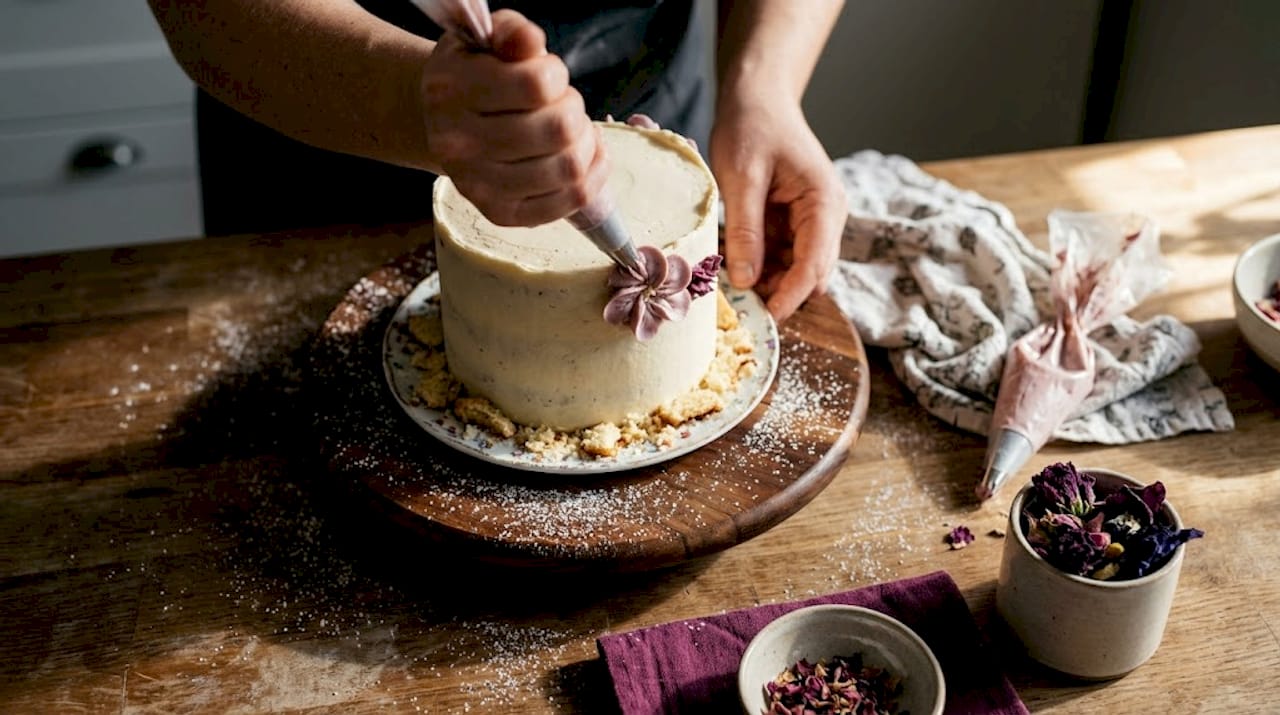
The key principle is asymmetry. Real flowers do not grow in neat, symmetrical clusters. They tumble, overlap, and lean. Recreating that sense of organic movement is what separates a natural-looking cake from one that looks like it was decorated by a machine.
Step-by-step arrangement guide:
- Identify your focal flower. This is your largest, most detailed bloom, usually placed slightly off-centre.
- Add two or three medium-sized flowers around the focal point, varying their angles slightly.
- Fill gaps with smaller blooms and buds. These create depth without competing for attention.
- Tuck in greenery. Piped leaves or fresh herb sprigs like rosemary or mint add a lush, garden-fresh quality.
- Add fresh edible flowers last, pressing them very gently into the buttercream.
- Step back. Edit ruthlessly. If something looks forced, remove it.
Asymmetrical placement and colour gradients combined with a mix of piped and fresh flowers creates the layered texture that reads as genuinely natural rather than manufactured.
“Soft colours and a light touch are everything. The cake should feel as though the flowers simply landed there.” Fiona Cairns, celebrated British cake designer, whose understated, professional approach champions subtlety over spectacle.
Varying pressure and angle as you pipe each petal creates natural-looking ruffles and curves. No two petals should look identical. That slight imperfection is exactly what makes the result feel real.
Pro Tip: Combine piped buttercream blooms with one or two fresh edible flowers for layered texture. The contrast between the two adds a richness that neither achieves alone. For more creative ideas, our guide to spring floral cupcake ideas and our tutorial on making sugar flowers are both worth exploring. You might also find some inspirational cake art helpful for visualising your arrangement before you begin.
Common mistakes and how to troubleshoot for a flawless finish
Perfect placement requires practical solutions to keep your creations looking fresh and professional. Even experienced decorators run into trouble. Knowing how to fix problems quickly is just as valuable as knowing how to avoid them.
The most common floral cake mistakes and how to fix them:
- Buttercream melting or sliding: This almost always comes down to temperature. Butter-based buttercream hardens better in the freezer than shortening-only versions. If your room is warm, chill the cake between stages and work quickly.
- Overfilled piping bags: A bag that is too full gives you poor control and tired hands. Fill bags halfway, twist the top firmly, and re-fill as needed.
- Flowers losing definition: If petals are blurring together, your buttercream is too warm or too soft. Pop the cake in the freezer for five to ten minutes and try again.
- Colours looking muddy or uneven: This usually happens when colours are not mixed thoroughly before loading the bag. Mix until completely uniform, then check on parchment before piping onto the cake.
- Flowers looking too uniform: Vary your pressure, angle, and the number of petals per bloom. Perfection is the enemy of natural.
- Fresh flowers wilting quickly: Add them as close to serving time as possible and store the finished cake in a cool environment.
Pro Tip: If your piped flowers start going soft mid-session, slide the cake into the freezer for ten minutes. The cold firms everything up beautifully and gives you a fresh, stable surface to continue on. This trick is especially useful in warmer kitchens during summer months.
Poor colour blending is one of the trickier problems to recover from once you are on the cake. If a section looks patchy or dull, a light dusting of colour dust over the top can unify the tones and add a professional shimmer. Our guide to cupcake piping swirls also covers pressure control techniques that translate directly to flower piping.
Why true floral cake elegance is about restraint, not excess
Having seen how to fix common issues, let us step back and challenge some decorating assumptions. The instinct when decorating a floral cake is to add more. More flowers, more colour, more detail. But the most stunning floral cakes we see, including those from celebrated designers like Fiona Cairns, are defined by what is not there.
Negative space is not emptiness. It is breathing room. It lets the eye rest and appreciate each flower individually rather than experiencing a wall of decoration. The bakers who truly master this style understand that restraint is a skill, and often a harder one to learn than the piping itself.
Soft palettes, asymmetrical clusters, and a willingness to leave parts of the cake bare are the hallmarks of genuinely elegant floral work. We always encourage bakers to step back after every few flowers and ask honestly: does this need more, or is it already there?
Developing your essential buttercream techniques gives you the confidence to know when to stop. And knowing when to stop is everything.
Where to find supplies for your next elegant floral cake
Having explored both the artistry and the practicality, you are ready to create. But getting the right supplies in place before you start makes the whole process smoother, more enjoyable, and honestly more successful.
At The Vanilla Valley, we have been supplying bakers across the UK with quality decorating tools and ingredients since 2009. Whether you need piping nozzles, natural food colourants, edible decorations, or cake boards, everything is in one place. We stock products suited to complete beginners and seasoned professionals alike, with free delivery options and next day delivery available. Pop into our North Cardiff store or browse our full range of decorating supplies in Cardiff online. We would love to be part of your next beautiful bake.
Frequently asked questions
What are the best edible flowers for elegant cake decorating?
Pansies, violets, and pesticide-free roses are excellent choices for their colour range, availability, and safe consumption when sourced from edible flower suppliers.
How do I achieve natural-looking colours in floral cakes?
Use natural fruit powders such as freeze-dried raspberry or butterfly pea flower to create soft, realistic hues that look genuinely botanical rather than artificially bright.
What to do if my buttercream flowers keep drooping?
Switch to American buttercream for stability and chill the cake between decorating stages, as it holds its shape far better than meringue-based alternatives.
Should I decorate a cold cake or at room temperature?
Always work on a well-chilled cake to keep buttercream firm and prevent flowers from slipping or losing their shape during decoration.
How do I keep floral cakes from looking too ‘busy’ or artificial?
Embrace asymmetry and negative space, vary flower sizes and tones softly, and resist the urge to fill every gap. Less really is more with elegant floral designs.
Recommended
- Beginner Cake Decorating Tips for Stunning Results - The Vanilla Valley
- How to instantly make your cakes look more professional - The Vanilla Valley
- Make your cakes look professional instantly: simple tips - The Vanilla Valley
- Make your cakes look more professional: step-by-step guide - The Vanilla Valley