
How to store sugar flowers for lasting cake decorations
TL;DR:
- Proper storage of sugar flowers requires keeping them in a cool, dark, and dry environment to prevent moisture, light, and temperature damage. Using airtight containers with silica gel packets and handling flowers only when fully dried ensures their longevity for months. Regular inspections and careful planning help decorators preserve their intricate creations, enabling beautiful results for every occasion.
There is nothing quite as disheartening as opening a box of sugar flowers you spent hours crafting, only to find them soft, crumbling, or faded beyond recognition. Whether you are preparing decorations for a wedding cake, a birthday showstopper, or a competition entry, proper storage is what separates a professional finish from a frustrating disaster. In this guide, we are going to walk you through everything you need to know, from understanding what damages your flowers to a clear, step-by-step storage routine that keeps them beautiful for months.
Table of Contents
- What damages sugar flowers and why proper storage matters
- Essential tools and materials for storing sugar flowers
- Step-by-step: How to prepare and store sugar flowers
- Ongoing care: Checking, maintaining, and troubleshooting
- How long do sugar flowers really last? Lifespan and timing tips
- A professional’s take: The details that truly make sugar flowers last
- Find everything you need for sugar flower success
- Frequently asked questions
Key Takeaways
| Point | Details |
|---|---|
| Keep moisture away | Always air dry sugar flowers fully and use silica gel to prevent softening and mould. |
| Choose the right container | Select airtight glass or non-airtight cake boxes depending on long-term or transport needs. |
| Store in ideal conditions | Maintain 30-60% humidity and cool temperatures away from light for maximum flower lifespan. |
| Check and maintain regularly | Inspect flowers every few months to catch issues early and refresh silica gel as needed. |
| Plan ahead for events | Make simple sugar flowers 2-3 weeks, intricate pieces 1-2 weeks before your cake date for best results. |
What damages sugar flowers and why proper storage matters
Sugar flowers are surprisingly fragile once you understand what they are up against. They might look delicate, but the real threats are invisible: humidity creeping in overnight, a window letting in afternoon sun, or a brief spell in a warm kitchen. These everyday conditions are far more destructive than most people realise.
The primary enemies of sugar flowers are moisture and humidity, which cause softening and mould; light exposure, which fades colours; physical pressure, which snaps petals; and temperature swings, which lead to cracking and melting. Consistent cool and dry storage is absolutely key for longevity.
Here is a quick summary of the main threats:
- Moisture and humidity cause sugar and gum paste to absorb water, turning firm petals soft and sticky
- Direct sunlight or bright artificial light bleaches food colours, making vibrant blooms look washed out
- Physical pressure from stacking or cramped packaging crushes delicate petals and thin stamens
- Temperature fluctuations from warm kitchens or near radiators create expansion and contraction, leading to cracks
A cool, dry, and dark environment is not just ideal, it is essential. Think of it like storing fine chocolate: even a brief exposure to the wrong conditions can ruin weeks of work. Learning to make edible decorations last is one of the most valuable skills any decorator can build.
The good news is that getting storage right is genuinely straightforward once you know what you are protecting against. It just requires a little planning and the right supplies.
Essential tools and materials for storing sugar flowers
With the risks understood, you will want to gather the right supplies before storing your sugar flowers. Having everything ready in advance means you are not scrambling at the last minute and risking accidental damage to freshly dried blooms.
Store fully dried sugar flowers in airtight glass containers or non-airtight cake boxes with silica gel packets to absorb moisture and prevent breakage.
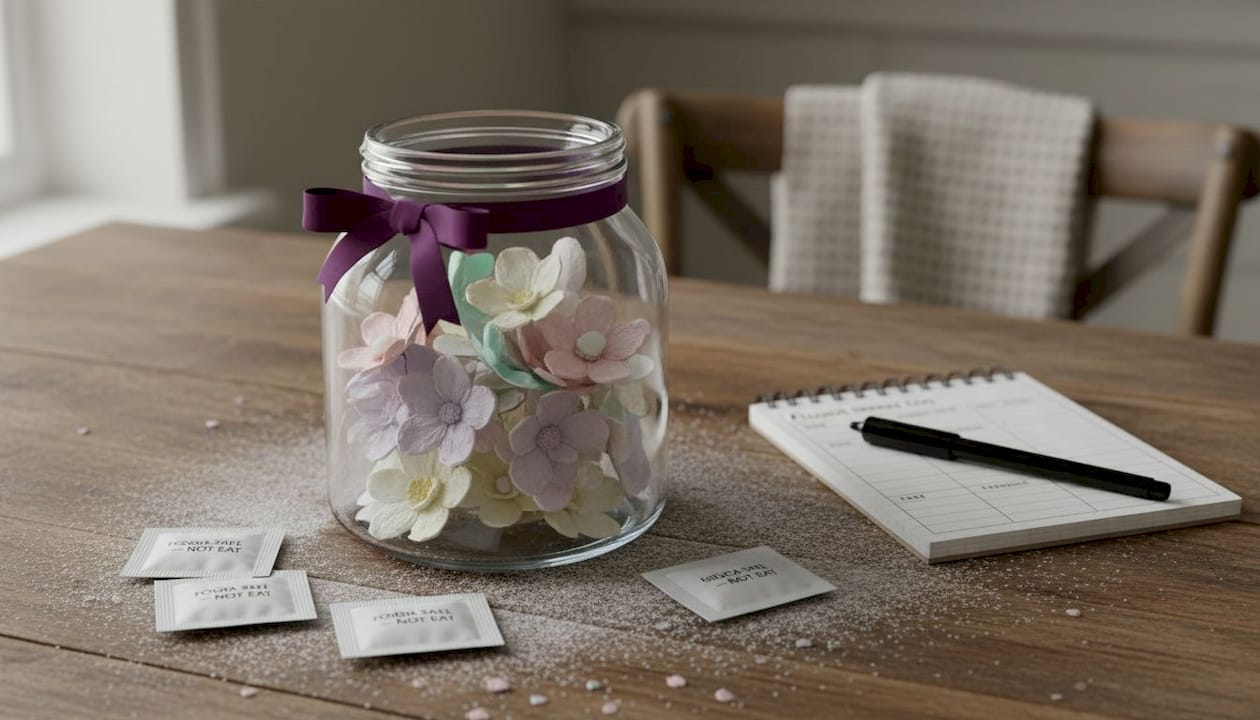
Here is a comparison to help you choose the right container for your situation:
| Container type | Best for | Pros | Cons |
|---|---|---|---|
| Airtight glass jar | Long-term storage at home | Excellent moisture barrier, reusable | Heavier, risk of breakage if dropped |
| Non-airtight cake box | Transport and short-term storage | Lightweight, allows slight airflow | Less protection against humidity |
| Cardboard storage box | Bulk storage, studio use | Spacious, easy to label | Needs silica gel to manage moisture |
| Clear acrylic box | Display and storage combined | Visible contents, smart finish | Can trap warmth if near a light source |
Beyond the container itself, here is what you will need in your storage kit:
- Silica gel packets to absorb ambient moisture inside the container
- White tissue paper or food-safe foam to cushion individual flowers
- Wire racks or foam pads for drying flowers before packing
- Sticky labels and a permanent marker for dating and identifying each batch
- A cool, dark cupboard or drawer away from the kitchen or bathroom
Pro Tip: Silica gel is incredibly effective, but always check that you are using food-safe versions if your flowers may end up on an edible cake. Replace packets annually or when they change colour to indicate saturation.
Investing in these materials is genuinely worth it. If you have spent four hours on a making sugar flowers project, protecting that work with a few pounds’ worth of supplies is an absolute no-brainer. Think of it as the finishing step, not an optional extra.
Step-by-step: How to prepare and store sugar flowers
Equipped with your tools, you are ready to follow a proven process to achieve the best possible results. The biggest mistake most decorators make is rushing this stage. Packing flowers before they are fully dry is the single most common cause of mould and softening in storage.
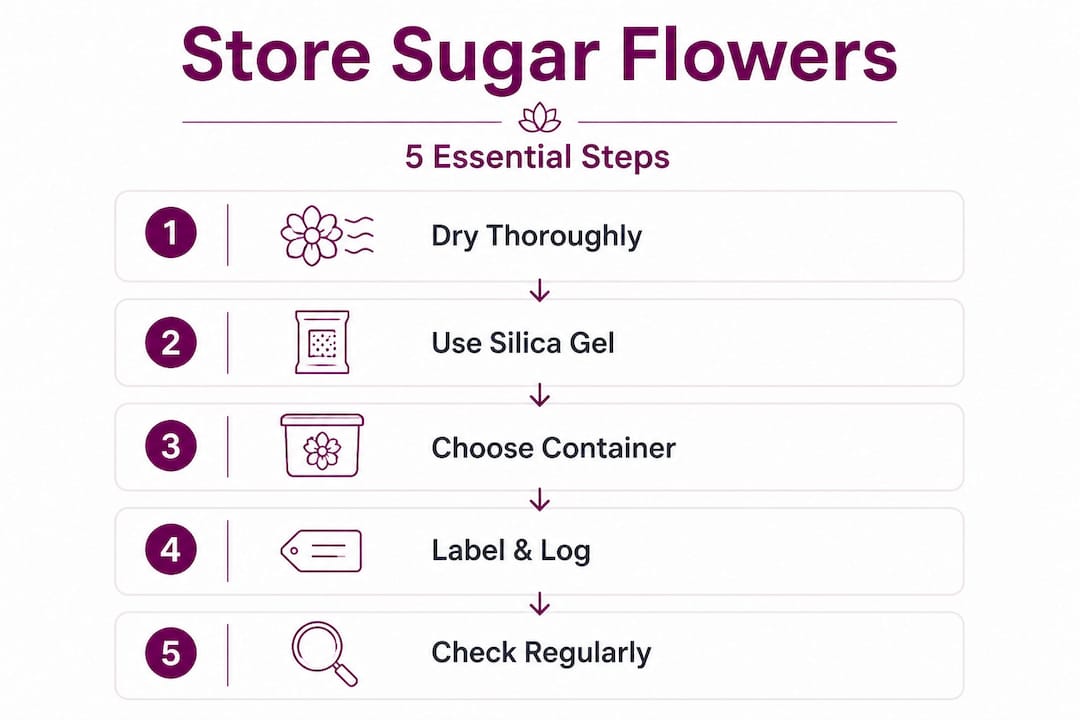
Air dry sugar flowers completely before storage: small flowers need 3 to 5 days, while larger blooms require 1 to 2 weeks on wire racks in a dark, cool, dry spot, turning every 2 days.
Follow these steps for perfect preparation:
- Place freshly made flowers on a wire rack or foam pad, ensuring petals are not touching each other to allow full airflow around every surface.
- Choose your drying spot carefully: a cool cupboard or spare room works brilliantly. Avoid the kitchen, where steam and warmth are constant problems.
- Turn each flower every two days so the underside dries evenly and does not develop flat spots or retain trapped moisture.
- Test for dryness by gently pressing the base of the flower. It should feel completely firm with no give whatsoever.
- Handle with care when moving dried flowers. Use a soft brush or foam-tipped tool rather than your fingertips where possible, as the natural oils and warmth of your hands can soften delicate areas.
- Place each flower individually onto a layer of tissue paper or foam inside your chosen container, avoiding any overlap between petals.
- Add silica gel packets before sealing or closing the lid. For glass jars, seal the lid. For cake boxes, close but do not tape shut, allowing minimal airflow.
- Label every container with the date made, flower type, and any relevant colour information.
Here is a useful reference for drying times based on flower size:
| Flower size | Examples | Minimum drying time |
|---|---|---|
| Small | Blossoms, small roses, leaves | 3 to 5 days |
| Medium | Peonies, large roses, dahlias | 5 to 7 days |
| Large and complex | Full bouquet focal flowers | 1 to 2 weeks |
Maintain storage in a cool environment between 60 and 75°F, with 30 to 60% humidity, away from direct sunlight, kitchens, bathrooms, heat sources, and extreme temperatures to avoid melting, cracking, fading, or mould.
Pro Tip: Write the date on each container in permanent marker and keep a simple notebook log of what is stored where. When you are juggling multiple cakes and events, this tiny habit saves enormous amounts of stress. It also helps you rotate your stock and use older flowers first.
Learning the right approach to storing sugarpaste alongside your flowers creates a joined-up storage routine that protects all your materials at once.
Ongoing care: Checking, maintaining, and troubleshooting
Once safely packed away, sugar flowers need regular checks and occasional maintenance for ongoing protection. It is tempting to pack them away and forget about them until the big day, but a quick periodic inspection can mean the difference between perfect flowers and a nasty surprise.
Check storage every 3 to 6 months: inspect for moisture and mould, air dry if needed, and replace silica gel annually.
Here is a simple inspection checklist to follow:
- Open each container and smell the contents. Any musty or unusual odour is an immediate warning sign.
- Visually inspect every flower for signs of softening, colour change, or white fuzzy patches that indicate mould.
- Check the silica gel packets. If they have changed colour from blue to pink (on indicator types), replace them immediately.
- If any flowers feel slightly soft but show no mould, remove them and allow them to air dry in a cool, ventilated spot for 24 to 48 hours before returning them to a fresh container.
- Discard any flowers with visible mould without hesitation. Mould spreads, and it is not worth risking your entire collection.
Common fixes to keep in mind:
- Soft but intact flowers: air out on a rack for a day, replace the silica gel, and re-box
- Faded colour: not reversible, but can be dusted with petal dust or lustre powder to refresh the finish
- Broken petals: keep snapped pieces safely as they can sometimes be used as filler flowers or accents
- Condensation inside a glass jar: remove all flowers immediately, dry thoroughly, and check your storage location for temperature fluctuation
“Always treat sugar flower storage as an ongoing commitment, not a one-time task. The decorators who get the best results are the ones who check in, replace silica gel regularly, and never store flowers in the kitchen, no matter how tempting it is.”
Keeping a simple log is honestly one of the most underrated habits in cake decorating. A small notebook or even a notes app entry with dates and observations can tell you a great deal about how your storage conditions are performing over time. Pairing good habits for storing fondant with your sugar flower routine means your whole decorating kit stays in peak condition.
How long do sugar flowers really last? Lifespan and timing tips
With proper storage and care covered, it is important to know how long your sugar flowers can be expected to stay at their best. This helps you plan your decorating calendar with confidence rather than guesswork.
With that in mind, here are some practical timing tips to help you plan:
- Gum paste flowers are the longest lasting and can remain in excellent condition for 6 to 12 months in perfect storage conditions
- Royal icing flowers hold well for several months but are particularly vulnerable to humidity cracking the icing surface
- Fondant flowers have the shortest shelf life, often 4 to 8 weeks, as fondant is softer and more moisture-sensitive
- Make your simplest flowers first, such as blossoms and leaves, as these can be prepared 2 to 3 weeks ahead without concern
- Save intricate focal flowers, like full peonies or roses with multiple layers, for 1 to 2 weeks before the cake is needed
How do you know if a flower is past its best? Watch for petal surfaces that feel slightly tacky rather than firm, any dullness or greyish tone that was not there originally, or a very faint sugary smell that has turned slightly stale. These are all signs the decoration is ageing and may not hold up on a finished cake.
Understanding the differences between materials is also key. The choice of sugar flower paste you use at the making stage directly affects how long your flowers will last in storage, so it is worth reading up on the options before you start.
A professional’s take: The details that truly make sugar flowers last
Here is something we have noticed after years of working with cake decorators at all levels. The most common storage mistake is not a lack of knowledge, it is impatience. Experienced cake artists will tell you that every shortcut comes back to bite you eventually.
The fridge, for example, seems like a logical place to store sugar flowers. It is cool and contained. But in reality, the fridge is one of the worst places for them. The humidity inside a standard fridge is far too high, and the temperature difference between the cold interior and a warm kitchen creates condensation the moment you open the door. Flowers stored in the fridge often arrive at events looking sweaty and soft. We have heard this story more times than we can count.
What experienced decorators do differently is build a storage routine before they even begin making the flowers. They pick their storage location first, set up their containers and silica gel, and make sure conditions are stable. Then they create. That forward planning means there is never a scramble at the end of a long session.
Record-keeping is another habit that separates the casual decorator from the consistent professional. Knowing that a batch of blush pink peonies was made on a specific date and is stored in container three means you can pull exactly what you need without rummaging and risking damage. It also gives you a real picture of how long your flowers hold up under your specific home or studio conditions.
The honest truth is that making decorations last is a discipline, not just a technique. You build it through small consistent habits, not one grand storage session. The bakers who nail it are the ones who treat storage as part of the creative process, not an afterthought.
Find everything you need for sugar flower success
Ready to take your cake artistry further? It starts with having the right resources at hand. Whether you are just beginning your sugar flower journey or you are a seasoned decorator looking to streamline your process, having quality supplies makes every stage more enjoyable and effective.

At The Vanilla Valley, we have been supporting bakers and decorators since 2009, and we know exactly what it takes to get beautiful results. From airtight storage solutions to the best flower pastes, food colours, and finishing dusts, everything you need is in one trusted place. Browse our full range of cake decorating supplies and take the next step towards sugar flowers that truly last. With free delivery options, next day dispatch, and a friendly team who genuinely loves this craft, we are here to help you every step of the way.
Frequently asked questions
Can I store sugar flowers in the fridge or freezer?
No, sugar flowers absorb moisture very easily and will soften, become sticky, or begin to melt if placed in a fridge or freezer, as temperature swings cause cracking and melting and refrigerators introduce far too much humidity.
What is the safest packaging for transporting sugar flowers?
A non-airtight cake box padded with white tissue paper or food-safe foam is ideal for transport, as it cushions the flowers against breakage while allowing a little airflow to prevent humidity build-up.
How do I tell if my sugar flowers have gone bad?
Look for softening petals, a musty or stale smell, visible mould, or faded colour, and if you spot any of these signs of moisture or mould, the flowers should be discarded rather than used on a cake.
How early can I make sugar flowers before a cake event?
Simple flowers can be made 2 to 3 weeks in advance, while complex, multi-layered designs are best completed 1 to 2 weeks before the event when stored in ideal conditions.
What humidity is best for storing sugar flowers?
Aim for 30 to 60% humidity in a cool, dry location between 60 and 75°F to keep sugar flowers firm, vibrant, and free from mould throughout their storage period.
Recommended
- How to make sugar flowers for wedding cakes in 2026 - The Vanilla Valley
- How to Store Sugarpaste for Freshness and Easy Use - The Vanilla Valley
- How to store fondant for lasting freshness and usability - The Vanilla Valley
- How to store cakes for lasting freshness and flavour - The Vanilla Valley
- Guia para usar papel de açúcar em bolos personalizados